Your Client’s Smartwatch Is Now a Witness – On Both Sides of the Table
The New Reality in PI Evidence
Not long ago, advising PI clients about digital footprints meant one thing: stay off social media. Don’t post photos from the beach if you’re claiming a back injury. That conversation is now the bare minimum.
In 2026, insurance investigators and defense attorneys are using far more than Facebook photos to challenge injury claims. Your client’s smartwatch activity, GPS records, ride-share history, delivery app usage, and even vehicle data can all become part of an investigation. And unlike social media posts – which clients can be told to avoid – wearable devices are recording constantly, often without the client thinking twice about it.
By 2025, wearable devices had become common household items. Industry reports estimate that global wearable shipments reached more than 611 million units, with around 562 million people worldwide using smartwatches regularly. Nearly 30 percent of adults in the United States wore some form of health-tracking device. Which means your client almost certainly has one – and so does the defense’s investigator.
What the Data Actually Contains
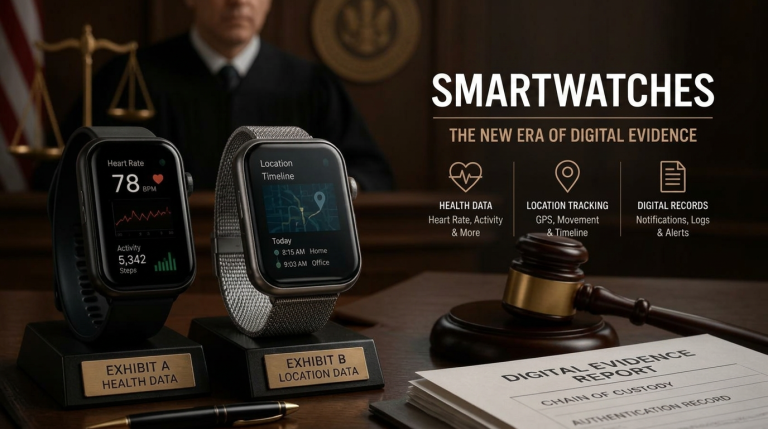
The sheer depth of information captured by modern wearables is immense. Fitness trackers and smartwatches capture precise heart rate fluctuations, sudden motion changes, gravitational impacts, GPS coordinates, sleep patterns, and hard-fall detection alerts. This data allows teams to reconstruct accidents, build exact timelines, and accurately track post-accident physical decline.
During an accident, a smartwatch does more than just log an impact; it records the physical trauma of the event. The device logs sudden gravitational shifts alongside immediate, massive spikes in heart rate, providing objective, timestamped biological proof of the exact moment a trauma occurred.
For plaintiffs, this can be an incredible asset. An Apple Watch that logs a crash detection alert records an instantaneous heart rate surge, and documents a permanent drop in daily step counts over the next six weeks offers highly persuasive, objective data that defense experts cannot easily hand-wave away.
However, that exact same device can effortlessly tank a case. If a client alleges a completely debilitating spinal injury, but their fitness tracker logs an intense, high-calorie workout a week later, the defense will use those metrics to destroy the client’s credibility and end the litigation.
The Cases That Defined This Landscape
Courts have been navigating wearable tech discovery for nearly a decade, and the jurisprudence has solidified rapidly:
- Cory v. George Carden International Circus, Inc.: An early milestone where a federal court ordered a personal injury plaintiff to turn over all “fitness monitoring accessories,” including Fitbits and GPS tracking systems, ruling the metrics directly relevant to the plaintiff’s physical injury and disability claims.[1]
- Bartis v. Biomet, Inc.: This stands as the foundational civil authority on wearable discovery.[2] The plaintiff alleged intense pain and limited mobility following an artificial hip implant but admitted during discovery that he wore a Fitbit that tracked his daily steps, heart rate, and sleep. When the defense demanded the data, the plaintiff objected, calling the tech unreliable and the request an overly burdensome invasion of privacy. Judge Ross rejected the objection, ordering the production of step-count data because physical activity was directly relevant to the injury. However, the court did allow the redaction of sleep, heart rate, and location metrics as overly sensitive. Addressing the reliability argument, Judge Ross wrote clearly “That argument clearly goes to admissibility and weight, not discoverability.” [3]
- State v. Dabate: The criminal courts provided the most dramatic proof of wearable data’s power.[4] A husband claimed an intruder murdered his wife, Connie Dabate; however, her Fitbit documented her walking around the family home for nearly an hour after the alleged time of the attack. This data mismatch secured a murder conviction and a 65-year sentence. In 2025, the Connecticut Supreme Court affirmed the conviction, ruling that wrist-worn sensor data is reliable scientific evidence.[5] This precedent easily crosses over into civil law if a device’s data is reliable enough to secure a murder conviction, it is reliable enough to evaluate a personal injury claim.
- The Pacemaker precedent: In another notable case, Ohio police secured a warrant for pacemaker data from Ross Compton, who was accused of arson.[6] A cardiologist reviewed the implant’s logs and concluded that Compton’s heart rate metrics made his story of carrying heavy items out of a burning house highly improbable. The trial court refused to suppress the data, establishing that implantable medical devices fall squarely within the boundaries of discoverable digital evidence.
Discovery Is Already Here
Defense attorneys have become incredibly sophisticated in their digital discovery requests. They are no longer just asking for basic step counts. Defense teams are explicitly demanding active energy metrics, stand minutes, flights of stairs climbed, exercise logs, sleep architecture, and heart rate variability, all data tucked inside Apple Health or Google Fit profiles that clients rarely know how to export themselves.
In fact, wearable device data frequently qualifies as an “initial required disclosure” under Federal Rule of Civil Procedure 26(a)(1) because it directly relates to the physical allegations in a PI complaint.[7] As Bartis made clear, reliability objections cannot block discovery; the data must be produced first, and arguments over accuracy happen later.
Critically, if a client deletes wearable data after an accident, it can constitute spoliation of evidence. While advising a client to turn off a tracker going forward is one thing, wiping historical records once litigation is foreseeable can trigger devastating adverse jury inferences and severe judicial sanctions.
Admissibility – Where Courts Stand
Following the Connecticut Supreme Court’s 2025 validation in State v. Dabate, courts generally admit wearable metrics if three foundational criteria are met, such as relevance to the core claims, verified authenticity (proof it has not been tampered with), and foundational reliability (sound data collection methods).
Authenticity can be established via Federal Rule of Evidence 901(b)(1) through the user’s own testimony, Rule 901(b)(4) via the data’s unique internal characteristics, or Rule 901(b)(3) by using a digital forensics expert to verify the data’s origin.[8]
While the reliability hurdle is real, wearables can misinterpret data, like counting a bumpy car ride as walking steps, the proponent of the evidence simply needs to present manufacturer data on error rates or show how system updates correct anomalies. Even if the raw data itself faces admissibility roadblocks, an expert witness can still legally rely on it to form the basis of their trial testimony under Federal Rule of Evidence 703.[9]
The Privacy Battleground
The defense does not have a license to embark on boundless fishing expeditions. In Spoljaric v. Savarese, a New York court flatly denied a defense request for a plaintiff’s Fitbit data regarding weight loss, labeling it an unsupported fishing expedition.[10] This ruling provides a vital shield against defense overreach.
Furthermore, health data stored on a commercial wearable device does not receive the same automated statutory protections as formal medical records held by healthcare providers. Courts balance the strict relevance of the data against the user’s privacy. As Bartis demonstrated, proportionality is the key, such as step counts were relevant to a physical mobility claim, but sleep architecture and heart rate logs were not, and were properly redacted. This gives plaintiffs’ firms a powerful strategic lever to limit scope, like a broken wrist claim never justifies surrendering 24 months of sleep cycles, heart rate variability, and GPS history.
What This Means for Your Practice – Right Now
The wearable evidence landscape requires PI firms to update three things immediately:
- Client intake. Add wearable device ownership to your standard intake questionnaire – every client, every case. Know what devices they have, what platforms sync to their phone, and how long data is retained. Many devices and cloud services automatically overwrite old data after as little as 14 to 30 days.
- Preservation letters. Issue litigation hold instructions that specifically cover wearable data at the moment of engagement. Instruct clients not to reset, delete, or factory-restore any device. Failure to preserve once litigation is foreseeable is a spoliation problem – and courts have not been sympathetic to the argument that the client did not know the data mattered.
- Proactive review. When a physician diagnoses a back injury and the client’s smartwatch data simultaneously shows a shift to a sedentary lifestyle, that correlation is powerful evidence for the plaintiff. Before opposing counsel requests the data, your team should be reviewing it – identifying corroborating patterns and spotting any inconsistencies before they surface at deposition.
[1] Cory v. George Carden Int’l Circus, Inc., No. 4:13-CV-760, 2016 WL 3460781, at *2–3 (E.D. Tex. Feb. 5, 2016).
[2] Bartis v. Biomet, Inc., No. 4:13-CV-00657-JAR, 2021 WL 2092785 (E.D. Mo. May 24, 2021).
[3] Id. at *3.
[4] State v. Dabate, No. TTD-CR17-0110576-T (Conn. Super. Ct. 2022).
[5] State v. Dabate, 351 Conn. 428, 331 A.3d 1159 (2025).
[6] State v. Compton, No. CR-2016-09-1422 (Ohio Ct. Com. Pl. Aug. 18, 2017).
[7] Fed. R. Civ. P. 26(a)(1).
[8] Fed. R. Evid. 901(b).
[9] Fed. R. Evid. 703.
[10] Spoljaric v. Savarese, 66 Misc. 3d 1220(A), 121 N.Y.S.3d 531 (Table), 2020 WL 611911 (N.Y. Sup. Ct. Jan. 28, 2020).
Related Content