
Depo-Provera: A Tentative Settlement, a Hearing That Still Matters, and 5,500 Plaintiffs Waiting for Answers
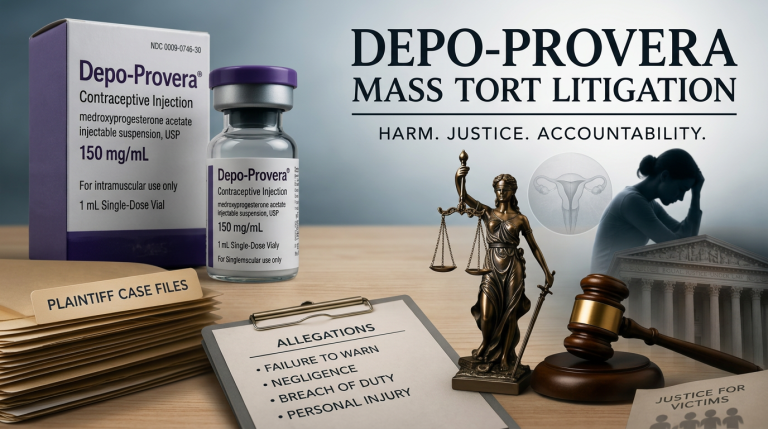
MDL-3140 | Northern District of Florida | Judge M. Casey Rodgers
A Settlement No One Expected This Early
On June 15, 2026, U.S. District Judge M. Casey Rodgers issued an order confirming that Pfizer and the plaintiffs’ leadership team had struck a global settlement in principle within the federal Depo-Provera meningioma MDL.[1]
The timing caught the mass tort bar completely off guard. Judge Rodgers had not yet ruled on Pfizer’s preemption motion, expert witnesses had yet to testify, and no bellwether trials had taken place. Settlements of this scale rarely surface so early in a litigation’s lifecycle. By moving to resolve the litigation before a single verdict, a Daubert ruling, or a preemption decision, Pfizer likely evaluated its exposure and decided that immediate certainly outweighed the gamble of a trial. Pfizer emphasized that this agreement carries no admission of liability or wrongdoing and does not impact cases currently moving through state courts.
What We Know and What We Do not
While the agreement offers eligible MDL plaintiffs a path to resolve their claims, it is not yet a finalized settlement, nor does it cover every single case.
The critical details remain strictly under seal. Specific compensation amounts and terms have not been disclosed while both sides work to finalize the framework. We know the global agreement involves roughly 3,400 lawsuits, but it explicitly excludes state court actions, the majority of which are pending in New York and Delaware.
The Background: What This Litigation Is About
Depo-Provera is an injectable hormonal contraceptive manufactured by Pfizer. Plaintiffs allege that the contraceptive causes meningioma brain tumors and that Pfizer failed to warn patients and providers for decades, despite mounting scientific evidence.
The science linking Depo-Provera to meningioma has been developing for forty years. As early as 1983, a study published in the European Journal of Cancer & Clinical Oncology reported the presence of progesterone receptors, and the absence of estrogen receptors in human intracranial meningioma cytosols.[2] By the time the settlement was announced, the MDL had expanded to over 3,400 lawsuits as the defense found the scientific data increasingly difficult to dismiss, and plaintiffs prepared to show that long-term use drastically spikes meningioma risks.
At the heart of the legal battle was Pfizer’s primary defense: federal preemption. Pfizer argued that because the FDA had previously rejected proposed label changes regarding meningioma risks, state-law failure-to-warn claims should be legally barred. Plaintiffs countered that Pfizer possessed clear risk data and simply failed to protect patients early enough. Judge Rodgers has since postponed a highly anticipated ruling on Pfizer’s pending motion for summary judgment regarding this preemption defense.
Why the Daubert Hearing on July 27 Still Matters
A settlement in principle does not completely close the book on this litigation. The court still intends to move forward with a Rule 702 hearing concerning expert witness testimony on general causation, specifically, whether Depo-Provera is biologically capable of causing meningioma brain tumors.[3] Originally set for late June, this hearing has been rescheduled for July 27, 2026, in Pensacola, Florida. Judge Rodgers noted that the upcoming general causation hearing remains vital because the finalized global agreement will not resolve every case in the MDL.
In a Daubert hearing, the judge acts as a legal gatekeeper for scientific evidence, ensuring an expert’s methodology is reliable before it ever reaches a jury.[4] Here, Pfizer is trying to disqualify the plaintiffs’ experts. These proceedings are critical: the rulings on expert admissibility will determine whether non-settling claims advance to bellwether trials or face potential dismissal, heavily influencing both the federal MDL and parallel state court dockets.
In April 2026, plaintiffs moved to exclude several of Pfizer’s defense experts, claiming they improperly minimized the causal link to brain tumors. Both sides have completed depositions for their general causation experts, fielding five experts each, and both have filed cross-motions to exclude the other side’s scientific opinions.
The Numbers Behind the Story
The June 1, 2026 statistics report from the Judicial Panel on Multidistrict Litigation (JPML) revealed staggering growth.[5] The Depo-Provera MDL added 1,739 pending cases in just one month, skyrocketing from 3,769 in May to 5,508 in June. This surged the litigation from 11th to 9th among the largest active MDLs in the country, accounting for more than 70% of the entire federal MDL system’s net growth that month.
This massive influx was fueled by two things – the lingering ripple effects of the FDA adding a meningioma warning to Depo-Provera’s label in December 2025 (prompting a wave of new filings ahead of case-management deadlines), and the urgency to join the MDL before the critical Daubert hearing settled the underlying science questions.[6]
What PI Firms Should Watch
For personal injury firms, the July 27 Daubert hearing creates a high-stakes window:
- If plaintiffs’ experts survive Daubert, the scientific foundation of the litigation holds. Non-settling cases gain massive leverage, state court filings in NY and DE are strengthened, and Pfizer will face intense pressure to increase settlement offers.
- If Pfizer excludes the plaintiffs’ experts, cases falling outside the global agreement face an incredibly steep uphill battle. The state court dockets which are not bound by federal Daubert rulings will become the main battleground, though they will lose significant momentum.
Ultimately, while the proposed framework intends to resolve claims for women meeting specific eligibility criteria, the final terms, deadlines, and claims processes remain under wraps. Firms must watch the July 27 hearing closely; it will dictate the value of every single case left outside the settlement
[1] In re Depo-Provera (Depot Medroxyprogesterone Acetate) Prods. Liab. Litig., No. 3:25-md-03140-MCR-HTC (N.D. Fla. June 15, 2026) (order confirming global settlement in principle), https://www.robertkinglawfirm.com/wp-content/uploads/2026/06/depo-provera-mdl-global-settlement-order-june-2026.pdf.
[2] M.A. Blankenstein et al., Presence of Progesterone Receptors and Absence of Oestrogen Receptors in Human Intracranial Meningioma Cytosols, 19 Eur. J. Cancer & Clinical Oncology 365, 365–70 (1983), https://doi.org/10.1016/0277-5379(83)90134-7.
[3] Fed. R. Evid. 702.
[4] Daubert v. Merrell Dow Pharms., Inc., 509 U.S. 579 (1993).
[5] U.S. Jud. Panel on Multidistrict Litig., MDL Statistics Report—Distribution of Pending MDL Dockets by District (June 1, 2026), https://www.jpml.uscourts.gov/sites/jpml/files/Pending_MDL_Dockets_By_District-June-1-2026.pdf.
[6] U.S. Food & Drug Admin., Depo‑Provera: NDA 020246/S‑074 & NDA 021583/S‑045 Prior‑Approval Supplemental Application Approval Letter (Dec. 12, 2025), https://www.accessdata.fda.gov/drugsatfda_docs/appletter/2025/020246Orig1s074,021583Orig1s045ltr.pdf.