Reading the Claim Before Searching the Prior Art: Why Claim Limitations Should Drive an Invalidity Search
In patent litigation, a prior art search can produce hundreds of potentially relevant references. Yet the number of documents identified is rarely the best measure of the search’s value. What matters is whether the evidence addresses the limitations that define the asserted claim—and whether the findings help the litigation team evaluate its position.
That is why an effective invalidity search should begin with the claim, not simply the technology.
A broad search can identify documents that describe similar products, related technical concepts, or comparable methods. But technical similarity alone does not establish that a reference addresses the limitations of an asserted claim. Without a claim-focused approach, researchers risk spending time collecting material that appears relevant at a high level but offers limited value when examined against the actual claim language.
The Claim Defines the Research Question
An asserted patent claim is not merely a description of the technology in dispute. Its individual limitations define the features, relationships, steps, or conditions that must be considered when evaluating potential prior art.
For this reason, claim analysis should precede decisions about search terms, databases, and research scope.
The USPTO’s Manual of Patent Examining Procedure emphasizes the importance of understanding the claimed invention and identifying individual claim limitations before conducting the prior art search. Although examination and litigation have different objectives and procedures, the underlying research lesson is relevant to both: the search must be informed by what the claim actually requires.
For litigation researchers, this means examining the claim language carefully, identifying its constituent limitations, and understanding how those limitations relate to one another. The goal is to translate the claim into a structured research framework without losing the technical specificity or relationships expressed in the original language.
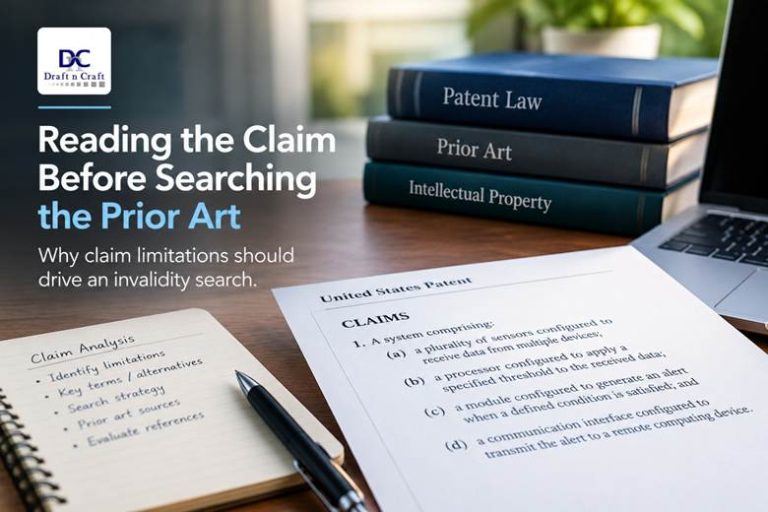
Consider a hypothetical claim directed to a system that:
- Receives sensor data from multiple devices.
- Apply a specified threshold to the received data.
- Generates an alert when a defined condition is satisfied.
- Transmits the alert to a remote computing device.
A search focused only on sensor systems or remote monitoring could return a substantial volume of relevant-looking material. However, a useful invalidity investigation must examine the specific limitations and their relationships. A document describing sensor data collection may be relevant to one part of the claim while offering no apparent disclosure of the threshold-based alerting process or remote transmission requirement.
The claim provides the framework for distinguishing between general technological relevance and evidence that may be material to the invalidity analysis.
Break the Claim into Searchable Limitations
Once the relevant claim has been identified, the next step is to break it into its constituent limitations.
This is not simply a formatting exercise. It helps researchers identify the different concepts, technical features, and relationships that need to be investigated.
A limitation-by-limitation review should consider several questions:
What does the claim expressly require?
Identify the technical components, operations, conditions, and relationships recited in the claim. Pay attention to functional language, qualifiers, sequencing, and limitations that might be overlooked when searching only for the central technology.
Which terms may have multiple technical meanings?
A claim term may be described differently across industries, technical disciplines, or generations of technology. Researchers should identify plausible terminology variations, synonyms, historical expressions, and alternative descriptions that could appear in earlier publications.
Which limitations are likely to require separate search strategies?
Some limitations may be readily identifiable through conventional keyword searches. Others may require classification-based searching, citation analysis, examination of patent drawings, technical literature, standards documents, or related patent families.
How do the limitations relate to one another?
Finding individual components in separate documents is not the same as finding a disclosure of those components arranged or operating as the claim requires. Researchers should preserve the relationships between limitations rather than treating each element as an isolated keyword.
This process creates a claim-focused search plan. It also makes it easier to document what has been found, which limitations remain insufficiently supported, and where additional research may be warranted.
Let the Claim Drive the Search Strategy
A claim-focused approach does not mean searching only the exact words appearing in the patent.
In fact, relying too heavily on the claim’s terminology can cause researchers to miss important prior art. Earlier publications may describe the same technical concept using different language, and relevant disclosures may appear in fields that are not immediately obvious from the patent’s title or abstract.
The claim should determine what the researcher is looking for, while the search strategy should remain flexible enough to find how others described it.
Depending on the technology and the limitations under investigation, this may involve:
- Keyword and synonym expansion: Identifying alternative terminology, abbreviations, historical expressions, and technical descriptions.
- Classification searching: Exploring relevant patent classes and subclasses to identify documents that may not use the expected terminology.
- Citation and family analysis: Following backward and forward citations, related applications, and patent-family connections to uncover additional leads.
- Non-patent literature research: Examining technical papers, industry publications, standards materials, product documentation, and other relevant sources where appropriate.
- Reference-led searching: Using promising disclosures to identify related documents, earlier implementations, and alternative descriptions of the same technical concepts.
The search should evolve as evidence emerges. A relevant reference may reveal terminology that was not apparent from the original claim analysis. A newly identified technical relationship may suggest another database, classification, or body of literature to explore.
The important distinction is that each expansion should remain connected to the research objective. Breadth is valuable when it improves the chance of finding meaningful evidence—not when it simply increases the volume of results.
Evaluate References Against the Actual Claim
Identifying potentially relevant prior art is only part of the exercise. Each promising reference must then be examined against the limitations it may meet.
This is where a claim chart or structured limitation matrix can become particularly useful. It records the relevant disclosure, identifies supporting passages or figures, and makes gaps in the available evidence visible.
For example, a limitation matrix might distinguish between a feature that appears to be expressly described in a reference, one that requires closer technical analysis, and one for which no supporting disclosure has yet been identified.
This approach helps the research team communicate findings more precisely. Rather than describing a document as broadly relevant to the patent, the report can explain which limitations it appears to address and why it merits further review.
It is also important to distinguish between different invalidity theories.
For anticipation under 35 U.S.C. § 102, the analysis generally requires a single prior art reference to disclose every claim limitation, expressly or inherently, arranged as required by the claim. For obviousness under 35 U.S.C. § 103, the analysis may involve multiple references, together with the applicable reasoning for why the claimed subject matter would have been obvious to a person of ordinary skill in the art.
Consequently, a reference that supports one or more limitations may still be useful without independently establishing anticipation. Equally, collecting separate disclosures for every limitation does not, in itself, establish obviousness. The significance of each reference depends on the applicable legal framework, the evidence, and the attorney’s analysis.
The deliverable research should make these distinctions clear without overstating what the evidence establishes.
Avoid the Trap of Searching with Hindsight
Another reason to begin with a disciplined claim analysis is to reduce the risk of hindsight-driven research.
Once the claimed invention is known, it can be tempting to search for documents that resemble the invention as it is now understood. Researchers may unconsciously favor familiar terminology or focus on passages that appear to support the desired conclusion while overlooking differences in the underlying technical disclosure.
A rigorous process requires examining the references in context. What did the document actually disclose? When was it publicly available relative to the relevant date? Does it describe the relevant feature, or does that interpretation depend on information supplied by the patent being challenged? Are there material differences between the reference and the asserted claim?
These questions help keep the research evidence based.
The relevant date, applicable prior art rules, and any claim-construction issues also matter. Where claim meaning is disputed, the research team should understand the working assumptions supplied by counsel and flag uncertainties that could materially affect the search. Researchers should not silently substitute their own legal interpretation for the attorney’s analysis.
The objective is not to force a reference into the claim. It is to identify what the reference genuinely contributes to the investigation.
Make the Research Useful to the Litigation Team
The final measure of an invalidity search is not simply how many references it uncovers. It is whether the findings are accurate, traceable, organized, and useful to the legal team.
A strong deliverable should help attorneys quickly understand:
- Which references appear most promising and why.
- Which claim limitations each reference may address.
- Where the supporting disclosure appears in the source.
- Which limitations remain unaddressed or require further investigation.
- What additional research avenues may be worth pursuing.
A clear limitation-level analysis also makes it easier to compare references, identify gaps, prioritize follow-up work, and decide where deeper technical investigation may be warranted.
For litigation teams working under demanding deadlines, this structure can reduce the effort required to move from a collection of documents to a meaningful evaluation of the available evidence.
Start with the Claim. Search with Purpose.
An effective invalidity search is not a race to collect the largest number of potentially relevant documents. It is a disciplined investigation guided by the language of the asserted claims and the specific questions the litigation team needs to answer.
Reading the claim first helps establish the research framework. Breaking it into limitations clarifies the evidence required. A targeted but flexible search strategy expands the opportunity to find relevant disclosures. And structured reference analysis makes the results easier to evaluate and use.
The process ultimately comes down to a simple principle: the claim should shape the search, and the evidence should shape the findings.
For patent litigators, the right question is not merely whether a reference concerns the same technology. It is what that reference actually discloses, which limitations it addresses, and how it contributes to the broader invalidity investigation.
That is where prior art research becomes more than document collection—and starts delivering meaningful value to the litigation team.
Draft n Craft supports IP litigation teams with prior art and invalidity searches, patent and non-patent literature research, claim-element mapping and chart support, patent-family and prosecution-history research, and related litigation research. Our role is to help legal teams investigate technical evidence and organize research findings to support their evaluation and strategy.