
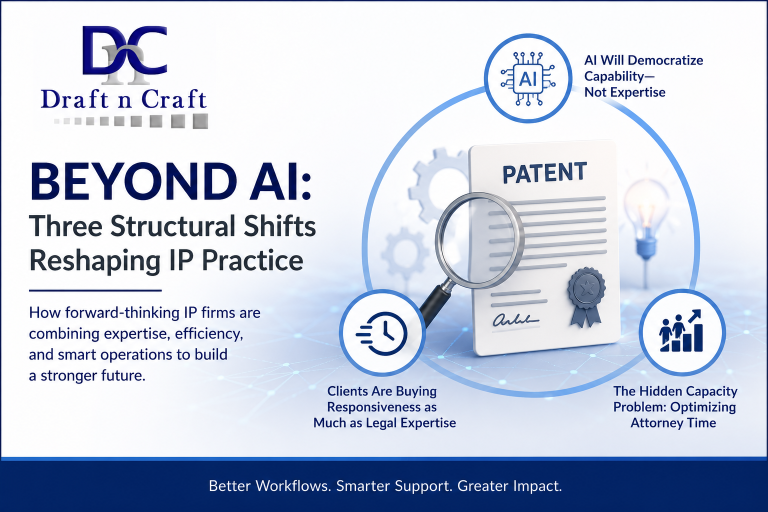
Beyond AI: Three Structural Shifts Reshaping IP Practice
By Arvinder Singh, Senior Vice President – IP Solutions, Draft n Craft
Artificial intelligence has dominated conversations across every industry over the past two years, and intellectual property is no exception. Nearly every conference agenda, webinar, and LinkedIn thread now treats AI as the central theme. The excitement is understandable, but I’d argue the conversation has gotten too narrow.
The future of IP practice isn’t simply about AI. It’s about how firms adapt to a much broader transformation in how legal services get delivered. Technology is only one part of that equation, evolving client expectations, growing operational complexity, shifting economics, and how well firms use the resources they already have matter just as much.
Having worked with IP attorneys, agents, and IP teams for over two decades, I’ve watched how the successful ones evolve. What stands out is that the firms consistently outperforming their peers are rarely the ones with the flashiest technology or the biggest teams. They’re the firms that make deliberate choices about where attorneys spend their time, how work moves through the organization, and how they create value for clients.
As I prepare for this year’s NAPP Annual Meeting, three structural shifts stand out to me as the ones most likely to shape where IP practice is headed.
1. AI Will Democratize Capability — Not Expertise
AI has already become a genuinely useful productivity tool in many IP practices. Summarizing prior art, organizing prosecution history, drafting first-pass documents, reviewing specifications, accelerating patent analytics — AI is cutting the time these routine tasks take, and that’s unambiguously a good thing.
But there’s a distinction here that often gets lost: once everyone has access to the same tools, the tools stop being a competitive advantage. What actually differentiates firms is the professional judgment sitting behind the technology.
AI can surface references, but it can’t tell you whether a claim strategy fits a client’s commercial goals. It can draft language, but it can’t negotiate with an examiner or navigate the nuances of prosecution strategy. It can summarize a document in seconds, but it can’t replace years of experience advising inventors on how to build a portfolio that actually matters.
AI expands capability. It doesn’t replace expertise.
The firms that get the most out of AI won’t be the ones trying to automate everything — they’ll be the ones using AI to clear away repetitive work, so their experienced people have more room for the complex legal and strategic decisions clients actually pay for.
2. Clients Are Buying Responsiveness as Much as Legal Expertise
For decades, law firms competed primarily on legal capability. That’s still essential — but today’s clients are evaluating outside counsel through a much wider lens. They expect timely communication, predictable turnaround, transparent reporting, consistent processes, and execution that just works.
From a client’s perspective, a brilliant office action response delivered three days late doesn’t feel brilliant. Inconsistent reporting, delayed filing confirmations, missed follow-ups, fragmented communication all of it chips away at client confidence, even when the underlying legal work is excellent.
That’s a real shift in how value gets perceived. Clients increasingly judge their experience not just by the quality of the legal advice, but by the quality of everything surrounding it. Operational excellence has stopped being a back-office function and become a genuine strategic differentiator.
Many firms pour resources into legal training and comparatively little into how work actually flows. A few questions worth sitting with:
- How quickly can new matters be opened?
- Are docketing processes standardized?
- Is client reporting consistent across the practice?
- Are filing workflows documented and repeatable?
- Can the practice scale without adding operational risk?
These sound like operational questions. They are, but they directly shape client satisfaction and, over time, the firm’s bottom line.
3. The Hidden Capacity Problem
The biggest challenge facing many firms right now isn’t a shortage of work — it’s how attorney time actually gets spent.
Ask almost any IP practitioner and they’ll tell you there aren’t enough hours in the day. But look closely at where those hours go, and a surprising share is absorbed by work that, while necessary, doesn’t require attorney-level judgment:
- Reviewing docket reminders
- Coordinating filing formalities
- IDS preparation and management
- Document formatting
- Status reporting
- Administrative follow-ups
- Signature coordination
- File organization
- Routine prosecution support
None of this is unimportant — it’s what keeps a practice running smoothly. But it’s also an opportunity. Every hour an experienced attorney spends coordinating paperwork is an hour not spent on strategic counselling, claim drafting, client development, or growing the practice.
The firms scaling well right now aren’t necessarily hiring more attorneys. They’re redesigning workflows so everyone works at the top of their expertise: attorneys focus on legal judgment, paralegals manage prosecution support, specialized operational teams handle the repeatable administrative work, and technology speeds up the routine task’s underneath all of it.
This isn’t just about cutting costs. It’s about getting more value out of every hour of professional time.
The Economics of Modern IP Practice
Behind all of this sits a commercial reality: running an IP practice is meaningfully more complex than it was even five years ago. Technology investment keeps climbing. Cybersecurity expectations keep rising. Clients want fixed or predictable pricing and hiring experienced talent has gotten more competitive — all while clients still expect faster turnaround without any drop in quality.
For a lot of firms, growing revenue alone isn’t enough anymore. Sustainable profitability increasingly comes down to operational efficiency. Every unnecessary handoff, duplicated effort, manual process, or avoidable delay leaves a mark on both client experience and the numbers.
That’s why the conversation is shifting — from “how can we do more work?” to “how can we deliver better outcomes with the expertise we already have?” It’s a more strategic question, and a harder one.
What Should Firms Do?
There’s no single blueprint, but a few principles show up consistently among the firms doing this well.
Use AI deliberately. Treat it as an accelerator, not a substitute for judgment. Every AI-assisted output should still pass through the lens of legal expertise and the client’s actual objectives.
Measure where attorney time actually goes. Understanding how professionals really spend their week tends to surface opportunities to delegate routine work and free up time for higher-value activity.
Standardize operational processes. Consistent workflows for docketing, filing, reporting, and communication reduce risk, improve quality, and make growth sustainable rather than fragile.
Build flexible support models. Workloads fluctuate. Practices that can scale operational support up or down — without permanently expanding overhead — tend to handle shifting client demand much better.
Looking Ahead
The future of IP practice won’t be decided by who adopts the newest technology first, or by who hires the most attorneys. It will be decided by the firms that figure out how to make expertise, technology, and operations work together.
AI will keep evolving. Client expectations will keep rising. Operational demands will keep getting more sophisticated. But one thing isn’t going to change: clients will always value sound judgment, thoughtful advice, and relationships they trust. The firms that succeed will be the ones that protect those high-value activities by building efficient, scalable operations around them.
In the end, this isn’t about replacing professionals with technology. It’s about freeing professionals up to spend more of their time doing the things only they can do.
That may turn out to be the most important competitive advantage of all.