FDA Orders NAION Warnings on All GLP-1 Drugs: What It Means for the Ozempic Vision-Loss Lawsuits
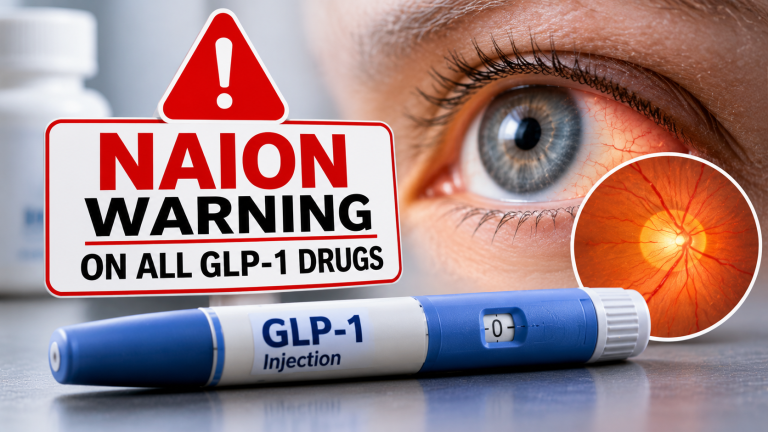
The FDA’s November 9, 2026 announcement marks an important development in the ongoing debate over the safety of GLP-1 medications. The agency is requiring manufacturers across the entire drug class to include warnings about non-arteritic anterior ischemic optic neuropathy (NAION) in the Warnings and Precautions section of their product labels.
NAION occurs when blood flow to the optic nerve is reduced, potentially causing sudden, usually painless vision loss. In some cases, the damage is permanent. The requirement applies to GLP-1 medications, including Ozempic, Wegovy, Mounjaro and Zepbound.[1]
According to the FDA, NAION cases have been reported across all currently marketed GLP-1 products, raising concerns about a “potential increased risk.” The agency began examining the issue after a 2024 study identified a possible association between semaglutide and NAION. Although that study had limitations, it prompted a broader review of clinical trials, animal data and real-world evidence.[2]
The numbers behind the FDA’s review provide some perspective. Its clinical-trial analysis covered 126 trials involving 134,253 patients and identified 15 probable NAION events. The reported incidence was 6.4 cases per 100,000 person-years among patients taking GLP-1 drugs, compared with 3.8 among those receiving placebo or other comparators. Its real-world analysis also found an increased risk compared with DPP-4 inhibitors (HR 1.43; 95% CI 1.02–2.01), although the comparison with SGLT-2 inhibitors was not statistically significant.[3] These findings raise concerns, but do not independently establish causation.
The United States is not the first jurisdiction to address the issue. The World Health Organization issued a medical product alert concerning semaglutide and NAION on June 27, 2025. The European Medicines Agency had already classified NAION as a very rare side effect of semaglutide, estimating that it could affect up to 1 in 10,000 users.[4] Australia’s Therapeutic Goods Administration subsequently updated warnings across the GLP-1 drug class in July 2026.[5]
What the Manufacturers Have Said
The manufacturers have responded cautiously to the FDA’s announcement. In statements to ABC News, Novo Nordisk maintained that the available data do not establish a cause-and-effect relationship between GLP-1 medications and NAION. Its spokesperson, Liz Skrbkova, also said the company remained confident in the benefit-risk profile of its medicines. Eli Lilly, meanwhile, stated that the FDA communication applies to all medicines with GLP-1 receptor agonist activity and does not identify findings specific to Lilly’s products. The company added that it was evaluating the update and would respond to the FDA.[6]
Where the Litigation Stands
The NAION vision-loss lawsuits are consolidated under MDL No. 3163 in the Eastern District of Pennsylvania, where Judge Karen Spencer Marston is overseeing the proceedings. She also presides over the separate GLP-1 gastrointestinal litigation. The Judicial Panel on Multidistrict Litigation established the vision-loss MDL in December 2025.[7]
Plaintiffs generally assert similar claims, including failure to warn, defective design and breach of warranty. A July 2, 2026 case management order directed the parties to focus initially on two issues, such as general causation and federal pre-emption, including the adequacy of existing warnings.[8]
The pre-emption question is particularly important. The court will need to consider whether the manufacturers’ FDA-approved labels already contained the warnings plaintiffs are seeking. If they did not, another question follows, as to would the FDA have rejected a request to add those warnings. The court has identified these as cross-cutting issues that could affect the entire litigation.[9]
The court also scheduled a Science Day for June 2, 2026, allowing the parties to present an overview of the medical and scientific issues surrounding GLP-1 medications and NAION.[10] It has since established a schedule extending into 2027, with expert reports, depositions and dispositive motions forming part of the next stages of litigation.[11]
What Attorneys Are Saying
From the Plaintiff-side, Attorney Melinda Helbock’s firm views the FDA’s decision as an important development for plaintiffs, particularly because a regulatory agency has now formally required NAION warnings. In its view, the decision supports the argument that the risk was knowable. This may be especially relevant to individuals who experienced vision loss when U.S. product labels contained no reference to NAION. At the same time, the firm acknowledges that the FDA describes the concern as a “potential” increased risk and that the clinical-trial findings involve relatively few events.
With respect to questions that remain, the legal examiner takes a more measured view. It recognizes that the labelling change gives existing and future plaintiffs another regulatory development to rely on but emphasizes that its legal implications are far from settled. One important question is whether the new warning will strengthen claims involving injuries that occurred before the labelling change. It also cautions against treating every vision-related complaint among diabetic patients or GLP-1 users as NAION. Establishing the connection in individual cases will require further medical and legal examination.
Jonathan D. Orent, a Motley Rice attorney and co-lead counsel in the NAION litigation, have emphasized as to Why the warning matters. The answer is that the central dispute is not whether GLP-1 medications offer medical benefits. Rather, he argues that patients and prescribing physicians were entitled to complete and timely inform about known or reasonably knowable risks so they could make informed treatment decisions. He has also highlighted the importance of discovery in determining what manufacturers knew, when they knew it and whether their warnings were adequate.
The Bottom Line
The FDA’s decision is a meaningful development in the GLP-1 vision-loss litigation. U.S. manufacturers must now specifically address NAION in their product labelling, bringing the United States closer to regulatory action already taken in Europe and Australia.
Still, the warning does not settle the question of causation. The FDA refers to a “potential increased risk,” and manufacturers maintain that the available evidence does not establish a causal relationship. The MDL court has placed general causation and warning adequacy at the forefront of the proceedings. For plaintiffs, the announcement provides an important regulatory milestone. Whether it ultimately changes the outcome of individual lawsuits, particularly those involving injuries before the warning, remains to be seen.
[1] U.S. Food & Drug Admin., FDA Requires Safety Labeling Changes for Glucagon-Like Peptide-1 Receptor Agonists (GLP-1 RAs) Due to Potential Increased Risk of Rare But Serious Eye Condition, https://www.fda.gov/drugs/drug-safety-communications/fda-requires-safety-labeling-changes-glucagon-peptide-1-receptor-agonists-glp-1-ras-due-potential.
[2] Jimena T. Hathaway et al., Risk of Nonarteritic Anterior Ischemic Optic Neuropathy in Patients Prescribed Semaglutide, 142 JAMA Ophthalmology 732, 732–39 (2024), https://doi.org/10.1001/jamaophthalmol.2024.2296.
[3] U.S. Food & Drug Admin., supra note 1.
[4] World Health Org., The Use of Semaglutide Medicines and Risk of Non-Arteritic Anterior Ischemic Optic Neuropathy (NAION),
[5] Therapeutic Goods Admin. (Austl.), GLP-1 RAs and Rare Vision Disorder, https://www.tga.gov.au/news/safety-updates/glp-1-ras-and-rare-vision-disorder.
[6] Shafiq Najib, FDA Orders New Warning on Ozempic, Wegovy, Other GLP-1 Drugs Over Rare Eye Condition, ABC News (Nov. 9, 2026),
[7] In re GLP-1 Receptor Agonists (GLP-1 RAs) Non-Arteritic Anterior Ischemic Optic Neuropathy Prods. Liab. Litig., MDL No. 3163,
[8] In re GLP-1 Receptor Agonists (GLP-1 RAs) Non-Arteritic Anterior Ischemic Optic Neuropathy Prods. Liab. Litig., No. 25-md-3163, Case Management Order No. 12, at 2–3.
[9] Id. at 5–6.
[10] In re GLP-1 Receptor Agonists (GLP-1 RAs) Non-Arteritic Anterior Ischemic Optic Neuropathy Prods. Liab. Litig., No. 25-md-3163, Case Management Order No. 6, at 1.
[11] In re GLP-1 Receptor Agonists (GLP-1 RAs) Non-Arteritic Anterior Ischemic Optic Neuropathy Prods. Liab. Litig., No. 25-md-3163, Case Management Order No. 14, at 1–2.
Related Content