Why Patent Litigation Changes the Way We Search for Prior Art
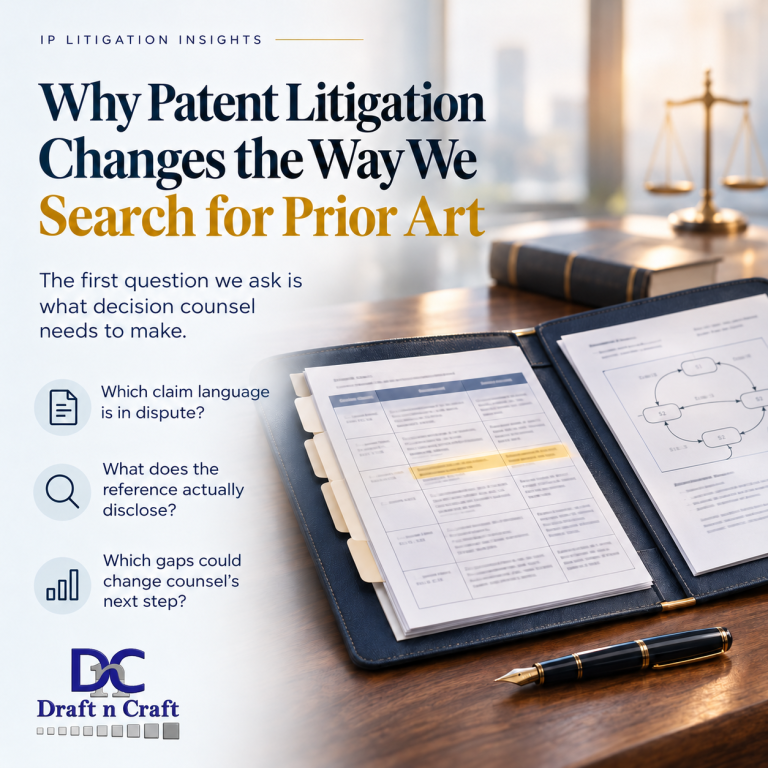
One of the first questions we would ask when a litigation team commissions an invalidity search is what decision the findings need to inform. A team preparing for an early client discussion may need to know whether there is enough substance in the art to justify deeper work. A team approaching an invalidity contentions deadline may already have a promising reference and need to know where it falls short. Both teams may start with the same patent. They should receive very different research.
That distinction is easy to miss because the work looks familiar. Researchers read patents, follow citations, and study how a technology developed. In a patentability search during prosecution, those activities commonly help counsel assess what might be patentable and where claim language could be refined. In litigation, the team is working with an issued claim and trying to understand what the available evidence can support under the positions being considered. A useful search can change the team’s next decision even when it turns up no obvious centerpiece for a challenge.
Start With the Decision Counsel Needs to Make
An instruction to find the best art against a patent gives a researcher a subject. A brief that identifies the asserted claims, the upcoming milestone, and the most consequential open question gives the researcher a way to allocate time. If counsel is deciding whether to devote expert time to a particular claim, an early assessment of the hardest limitations may be more valuable than a polished chart. When the task is to test a developed theory, the same effort may be better spent working through the strongest sources line by line and checking whether they support the proposed reading.
The brief should also make clear which assumptions counsel has settled and which are provisional. We would ask for the operative claim set, the relevant date or dates, and any working interpretations that could materially change the search. An asserted patent may list an early priority date, while counsel still needs to assess whether the relevant claim subject matter is supported as of that date. Research can continue while that issue is open. If a promising document falls between two dates counsel is considering, flagging it as contingent lets the team revisit it without repeating work or treating its eligibility as settled.
There is a practical advantage to putting these questions on the table early. Everyone can agree on what deserves an immediate call and what can wait for the next update. A newly found reference that appears to address a disputed limitation may warrant attention within hours. Five additional versions of a disclosure the team has already reviewed can usually wait. That shared judgment matters when several attorneys, technical experts, and researchers are working toward the same deadline.
Let the Disputed Language Guide the Work
Suppose an asserted claim describes a storage controller that accepts new writes only after it has synchronized outstanding changes with another device. An older publication describes both synchronization and write access. The valuable question is whether synchronization is a condition for accepting new writes, or whether the two operations simply occur in the same system. A state diagram, a description of recovery behavior, or an explanation of what the system does when synchronization fails may answer more than a dozen abstracts about replicated storage.
Working claim interpretations can change where the researcher looks. If the parties disagree about whether the condition applies to every write or only to writes during recovery, the corresponding research questions deserve to be tracked. An earlier design may support one reading and leave the other open. Recording the distinction early saves counsel from having to reconstruct which interpretation a researcher assumed after a chart has already been circulated.
The prosecution history can also help direct attention. If wording about the order of operations appeared in an amendment, the surrounding exchange may show why counsel should look closely at documents that describe the sequence. We would use that history to sharpen the research question and give counsel the relevant materials for interpretation. A reference considered during examination can also lead to a different technical paper, a related filing, or an earlier implementation that explains behavior the first disclosure leaves ambiguous.
Give Breadth a Purpose
When a limitation is difficult to find, a broader search can help. It works best when the team can explain what it is broadening. The terminology may be too modern. The patent classification may cover the product and miss the underlying mechanism. Or the most detailed descriptions may live in implementation guides written for engineers who already know the product category. Each diagnosis points to a different body of material.
Take terminology first. A paper may describe a design in terms of the failure it prevents, while a patent describes the same design through the steps that prevent the failure. Looking for the symptom, such as conflicting updates immediately after a system comes back online, can lead to literature that never uses the patent’s language. A migration guide can be especially helpful because it explains changes between versions and may point to release notes that reveal when a particular behavior appeared.
The same discipline applies to looking outside the immediate industry. Two fields can use similar expressions for mechanisms that behave differently. Before spending hours expanding into adjacent fields, we would compare what the systems receive, what triggers their response, and what happens if a prerequisite fails. That quick technical check gives the researcher a sound reason to pursue the area, and it gives counsel something concrete to discuss with an expert when the relevance is uncertain.
Report the Gaps While There Is Still Time to Act
A weekly update can say that thirty sources are under review and tell counsel very little. An update that explains that several disclosures show the same components, and that none of the reviewed passages yet explains the order in which they operate, gives counsel a decision to make. The team might ask an expert whether the sequence is described in a different vocabulary. It might pursue a designer’s papers or older implementation guides. It may also decide that another asserted claim deserves attention first.
At that stage we would distinguish what the source actually says from what the researcher thinks follows from it. A flowchart may show an operation after a checkpoint in one illustrated example. Whether the operation always depends on that checkpoint can require additional technical analysis. Keeping the original wording and the proposed inference visible helps counsel evaluate the argument and gives an expert a specific question to resolve.
We apply the same care to references that might work together. A diagram in one disclosure and a missing operation in another can suggest a line of inquiry. The research becomes more useful when it also shows why engineers at the time might have considered bringing the teachings together. A design guide that addresses the very problem encountered in the first system gives counsel a more concrete basis for review. A source showing that the two approaches assume incompatible operating conditions deserves to be surfaced just as promptly. Both findings can save the team from investing in a theory before it understands the technical premise.
Know What Another Day of Searching Could Change
Litigation teams often ask whether there is more art to find. As a budgeting question, we prefer to ask what another day of research could realistically change. If several different searches keep returning the same patent family, another round of minor keyword changes may add little. If a contemporaneous publication names a technical working group whose archives nobody has checked, there is a concrete reason to continue. That path has a plausible source, a specific gap to address, and a way to recognize a useful result.
Stopping points are especially important when the team will return to the research later. A short account of the sources searched, the lines of inquiry that had diminishing returns, and the leads that remain open can keep another researcher from starting from scratch after a claim construction ruling or a change in the asserted claims. It also gives counsel a fair reading of what an absence means. An undocumented result and a documented search across clearly defined materials carry different weight in a planning discussion.
Make the Handoff Easy to Challenge
Imagine counsel has ten minutes before a call with the client. What should they be able to learn from the first page of the research? In our view, they should see which references matter most, which claims or limitations those references appear to address, and what could change that assessment. The underlying chart should take the reader straight to the passage, figure, or version the researcher relied on. A secondary source can add context, and its role should be clear enough that nobody mistakes it for the direct disclosure.
We would also give counsel a clear account of the strongest evidence that cuts against the proposed reading. Where a manual describes an exception that the main diagram omits, the exception belongs with the diagram in the researcher’s analysis. Where a candidate depends on unresolved date evidence, that issue belongs alongside the technical assessment. Putting the uncertainty next to the finding lets counsel make an informed choice about further research, expert review, or the position to discuss with the client.
A patentability search can help a team decide how to seek protection. A litigation search can help a team decide how much confidence to place in a position it may have to defend under scrutiny. At Draft n Craft, that difference shapes how we think about the assignment from the first discussion. When counsel can follow a finding back to its source, see the limits of the evidence, and decide where the next hour of work belongs, the search has served the matter.