
The Ultra-Processed Food Lawsuit Just Got Dismissed – Twice. Here’s What That Means for the Litigation Ahead.
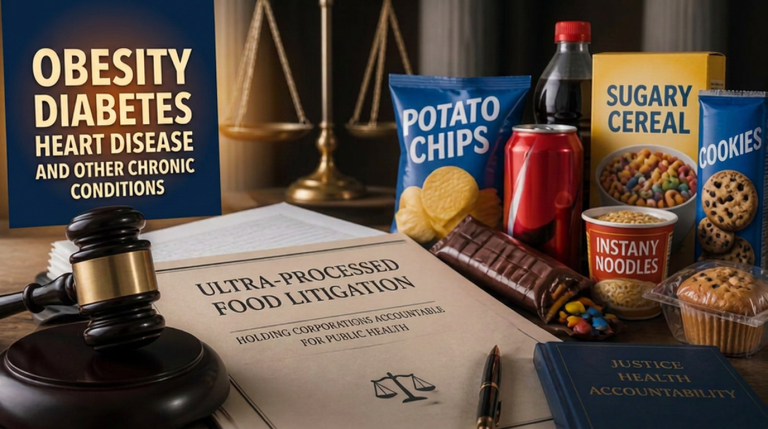
Martinez v. Kraft Heinz Company, Inc., et al. | No. 2:24-cv-05871 | E.D. Pennsylvania | Judge Mia Roberts Perez Dismissed with prejudice: June 30, 2026
The Case That Was Supposed to Be the Next Big Tobacco
When Bryce Martinez filed his lawsuit in December 2024, he was an 18-year-old who had already spent two years battling Type 2 diabetes and non-alcoholic fatty liver disease. His counsel at Morgan & Morgan, the largest personal injury law firm in the country had spent a year structuring the suit, hoping it would become the opening salvo in the “Big Tobacco” litigation of the 21st century. Martinez v. Kraft Heinz Company, Inc., et al., No. 2:24-cv-05871 (E.D. Penn. 2024)
The defendant list reads like a major grocery store chain, including Kraft Heinz Co., Mondelez International, Post Holdings Inc., The Coca-Cola Co., PepsiCo Inc., General Mills Inc., Nestle USA Inc., Mars Inc., Conagra Brands Inc., Kellanova, and WK Kellogg Co. The legal theory was bold with food giants deliberately having engineered ultra-processed foods (UPFs) to be addictive, having hidden their long-term health risks, aggressively marketed to minors, and subsequently causing a generation of children to develop chronic illnesses.
On June 30, 2026, U.S. District Judge Mia Roberts Perez permanently dismissed the case.[1]
What Happened – Twice
The Eastern District of Pennsylvania denied the plaintiff’s request to amend his complaint in what was widely seen as a litmus test for whether food and beverage giants could be held liable for damages linked to UPFs.
This was actually the second time the case was tossed out. The Martinez case was initially dismissed in August 2025 because the complaint failed to allege specific causation, lacking data on how often, in what quantities, and exactly when Martinez consumed the defendants’ products.
Given a second chance to cure these defects, Martinez’s legal team filed a massive, nearly 500-page proposed First Amended Complaint (FAC). The court still rejected it on essentially the same grounds.
“The FAC raises serious concerns about the UPF industry and its effects on children’s health,” Judge Perez wrote. “However, the law does not allow Martinez to hold liable an entire industry for these allegations.”
Crucially, the judge addressed a foundational legal barrier despite decades of federal health campaigns and extensive research highlighting the dangers of food processing, UPFs are not a distinct, legally regulated class of products. Legally, UPFs and their manufacturers are held to the exact same standards as any other food product on the market.
The Causation Problem – Why This Case Kept Failing
The dismissal was not because the court doubted the health risks of ultra-processed foods. It failed strictly on the legal mechanics of causation. The court highlighted the “unique challenge” of proving causation when a massive variety of products are consumed over many years, ruling that simply alleging an increased risk of disease is not enough to prove a specific product caused an illness.
Martinez pointed to over 100 foods, eventually expanding to 179 specific products as the collective cause of his illnesses. That sweeping scope proved fatal to the case. The FAC failed to establish “but-for” causation because it lacked facts proving that each individual defendant or product directly contributed to his injuries. If one removes a product or one defendant from the equation, the outcome remains unchanged, which highlights the structural flaw in the pleading.
The court also shut down creative workarounds, rejecting the plaintiff’s attempts to rely on alternative or market-share liability theories. Plaintiffs cannot bypass product-specific causation simply by suing an entire industry at once.
What the Ruling Means for the Broader UPF Litigation
Despite this blow, UPF litigation is far from dead. The current landscape shows a highly active arena:
- Seven other personal injury cases remain pending: Several of these actions, such as Lawton v. Kraft Heinz, currently facing a motion to dismiss, target far fewer brands than the 179 cited by Martinez.[2] A tighter, narrower approach may survive where Martinez collapsed.
- Morgan & Morgan has already pivoted: In March 2026, the firm launched a new federal suit, Ford v. Kraft Heinz Company, et al., on behalf of a 14-year-old with Type 2 diabetes.[3] While targeting the same general group of defendants, the Ford complaint explicitly outlines the exact frequency and volume of the plaintiff’s consumption of specific products. At 321 pages and over 1,700 paragraphs, it is more than double the size of the original Martinez filing.
- San Francisco’s City Attorney is pursuing a public enforcement action: In December 2025, San Francisco’s City Attorney, with Morgan & Morgan acting as co-counsel, filed an action against these same food giants.[4] Instead of relying on individual injury claims, this lawsuit is built on public harm. By taking the governmental route, the suit completely avoids having to prove individual consumption metrics and specific medical outcomes. Many experts view this as a much smarter, more viable legal path.
- A boost for defense dismissals elsewhere: Food companies like Kraft Heinz, Nestle, and Coca-Cola are already using Judge Perez’s ruling to push for dismissals in other jurisdictions. Federal judges in Mississippi, New York, Arkansas, and Louisiana are currently handling pending UPF cases and will be watching closely to see if Martinez is appealed to the Third Circuit.
Going Forward – What PI Attorneys Need to Know
The Martinez dismissal does not close the door on UPF litigation. It provides the blueprint for how future cases must be built. Plaintiffs will need to bring specific products, specific manufacturers, clear exposure histories, and ironclad science establishing both general and specific causation.
For PI firms, the operational takeaways are clear:
- Specificity is non-negotiable: Broad, industry-wide complaints will be thrown out. Firms must sign clients who can meticulously document exactly what they ate, how often, and over what timeframe to tie a specific product directly to an injury.
- Fewer defendants, tighter facts: The suits most likely to withstand initial motions to dismiss will target fewer companies with highly focused, individualized dose-response data.
- Governmental plaintiffs have the near-term edge: The San Francisco City Attorney’s public enforcement action sidesteps the individual causation trap entirely. State attorneys general and city attorneys filing consumer protection or public nuisance claims are positioned to advance much faster than individual personal injury actions.
- The underlying science continues to strengthen: Researchers are steadily publishing studies connecting UPF diets to severe chronic illnesses. For example, a January 2026 study revealed that Black women with breast cancer who heavily consumed UPFs prior to diagnosis suffered significantly lower survival rates.[5] As this scientific foundation matures, satisfying courts on general causation will become easier.
The Bottom Line
UPF litigation is not over; it is being refined. What started as a sweeping, tobacco-style industry assault has been reshaped by federal courts into a more targeted, evidence-intensive model. Firms that invest the resources to build tight, product-specific exposure records will lead the next wave of litigation. Those that file massive, generalized complaints against dozens of brands without documentation will see swift dismissals.
The court acknowledged that the health risks UPFs pose to children are deeply serious; the law simply demands that plaintiffs prove it one specific product at a time.
[1] Martinez v. Kraft Heinz Co., No. 2:25-cv-00377, 25-377 (E.D. Pa. June 30, 2026), available at https://www.casemine.com/judgement/us/6a46ae726720be855d6014dc
[2] Lawton v. Kraft Heinz Co., No. 1:26-cv-00044 (S.D. Miss. filed Feb. 12, 2026).
[3] Ford v. Kraft Heinz Co., No. 3:26-cv-00077 (E.D. Ark. filed Mar. 5, 2026).
[4] People of the State of California v. Kraft Heinz Co. et al., No. CGC-25-611986 (Cal. Super. Ct. Dec. 2, 2025).
[5] Tengteng Wang et al., Ultra-processed foods consumption and subsequent mortality in a cohort of Black breast cancer survivors, 80 eClinicalMedicine 102944 (Jan. 2026).