
The AI Verification Layer: What Every PI Paralegal Should Check Before a Filing Reaches the Attorney
AI can produce a polished motion in minutes, but polish does not guarantee accuracy. A convincing citation may refer to a nonexistent decision or misrepresent what a real court actually held. According to Damien Charlotin’s AI Hallucination Cases Database, more than 2,000 cases involving AI-related errors had been recorded worldwide by mid-September 2026, including 1,396 in the United States.[1]
For paralegals in personal injury practices, the gap between completing a draft and sending it to the attorney now deserves closer attention. Courts and legislatures are introducing verification requirements, making a reliable review process an increasingly important part of the job.
Florida’s New Requirement
On May 28, 2026, the Florida Supreme Court amended Rule 2.515(d)(2), effective June 15, 2026. Anyone signing a filing represents that “the legal authorities identified exist and are accurately cited.”[2] After notice and an opportunity to be heard, courts may impose sanctions ranging from reprimand and contempt to striking the document, dismissal, costs and attorneys’ fees.
The rule applies to attorneys and self-represented litigants, regardless of whether AI was used. The representation belongs to the signer, and not the paralegal. Administrative Order AOSC26-12 also preempts circuit-level orders requiring separate AI certifications, establishing one statewide standard.[3] In practice, paralegals often perform the checks that support the attorney’s final review.
Where AI Errors Hide
AI can help draft motions involving negligence, premises liability, damages, discovery disputes and expert testimony. But errors can take several forms, such as fabricated cases, altered quotations, misrepresented holdings, incorrect pinpoints, outdated decisions and out-of-state authorities presented as binding. A genuine case used to support a proposition it never addressed can be just as damaging as a completely fabricated citation.
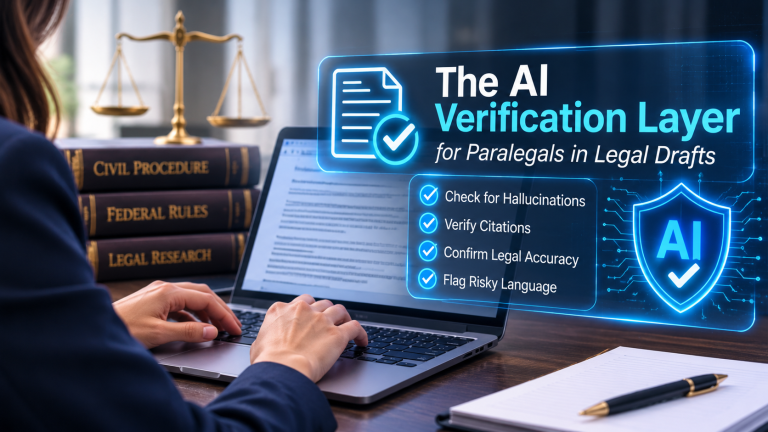
Treat verification as part of drafting, is not a last-minute proofread. A practical process should include locating every authority, reading the decision, checking quotations and pinpoints, reviewing subsequent history, checking official sources, and maintaining a verification log.
Why the Handoff Matters
A July 2026 California appellate decision illustrates what can go wrong when verification responsibilities are unclear. In Del Biaggio v. Bansen, the First District Court of Appeal sanctioned an attorney $1,500 after an appellate brief contained fabricated quotations.[4]
The attorney had added AI-generated quotations during recesses in another trial and asked his paralegal to verify them. She believed he had already checked the additions, having verified the sources in an earlier draft. The court described this as a communication error but made clear that assigning a paralegal to check citations without the attorney personally reviewing the authorities was inappropriate.[5]
The court also relied on Noland v. Land of the Free, L.P., which imposed $10,000 in sanctions and emphasized that attorneys must read the authorities they cite.[6]
The takeaway is straightforward, which includes communicating exactly what has been checked, by whom and what remains outstanding. A paralegal’s verification supports the attorney’s responsibility and does not replace it.
Confidentiality and Other States
Verification is only part of the picture. PI files contain sensitive medical and personal information, so firm-approved AI tools are essential. ABA Formal Opinion 512 (2024) explains that existing duties, including competence, confidentiality, supervision and candor toward the tribunal, apply to generative AI.[7] Lawyers’ supervisory responsibilities also extend to nonlawyer assistance under Model Rules 5.1 and 5.3.[8]
Other states are taking similar steps, such as:
- New York. Part 161, effective June 1, 2026, permits AI-assisted drafting without mandatory disclosure. However, courts adopting its model rule require independent review to ensure that submissions contain no fabricated or fictitious authorities.[9]
- Indiana. An order dated July 14, 2026, effective August 1, amended Trial Rule 11 and introduced Rule 11.1, establishing related authenticity and filing requirements for attorneys and self-represented parties.[10]
- California. Senate Bill 574, effective January 1, 2027, requires reasonable verification and correction of AI-generated material, protects confidential information and requires disclosure of AI use to courts. It also requires attorneys personally to read and verify citations in court filings, regardless of their source.[11]
Before sending a draft, one must check the applicable court and judge requirements, verify every authority and quotation, review citator results, complete the verification log and flag unresolved issues for the attorney.
The rules differ, but the message is consistent. AI may assist with drafting, yet someone must stand behind every authority submitted to the court. For PI paralegals, careful verification and clear communication are becoming essential professional skills. Done consistently, they make the attorney’s final review more reliable and, just as importantly, build professional trust.
[1] Damien Charlotin, AI Hallucination Cases Database (Sept. 2026), https://www.damiencharlotin.com/hallucinations/.
[2] In re Amendments to Fla. R. Gen. Prac. & Jud. Admin. 2.515, No. SC2026-0673, at 1–3; Fla. R. Gen. Prac. & Jud. Admin. 2.515(d)(2)(D).
[3] Fla. S. Ct. Admin. Order No. AOSC26-12, at 1–2.
[4] Del Biaggio v. Bansen, No. A174647, slip op. at 16–19 (Cal. Ct. App., First App. Dist., Div. Four July 10, 2026)
[5] Id. at 17–19
[6] Noland v. Land of the Free, L.P., 114 Cal. App. 5th 426, 445–48
[7] ABA Comm. on Ethics & Pro. Resp., Formal Op. 512 (2024).
[8] Model Rules of Pro. Conduct rr. 5.1, 5.3 (Am. Bar Ass’n 2024).
[9] 22 N.Y.C.R.R. §§ 161.1–161.4 & app. A (2026); In re Addition of Part 161 to the Rules of the Chief Administrator of the Courts, Admin. Order No. AO/75/26
[10] In re Amendments to Ind. Rules of Trial Procedure, Cause No. 26S-MS-8 (Ind. July 14, 2026); Ind. Trial Rules 11, 11.1
[11] S.B. 574, 2025–2026 Reg. Sess., ch. 858, 2026 Cal. Stat. (approved Sept. 30, 2026); Cal. Bus. & Prof. Code § 6068.1(a)(3)(A)–(C) (2027); Cal. Civ. Proc. Code § 128.7(b)(2)(A) (2027).