The Difference Between a Patent Search and an Invalidity Search
At first glance, a patent search and an invalidity search may appear to be variations of the same exercise.
Both involve patents.
Both involve prior art.
Both require searching technical literature.
And both ultimately involve finding information that predates a particular patent or application.
But the similarity largely ends there.
The purpose of the search changes the way the research needs to be conducted.
A prosecution search is generally concerned with identifying prior art that may be relevant to the patentability of an invention.
An invalidity search has a different question to answer:
Can we identify prior art that could meaningfully challenge one or more asserted patent claims?
That difference is significant.
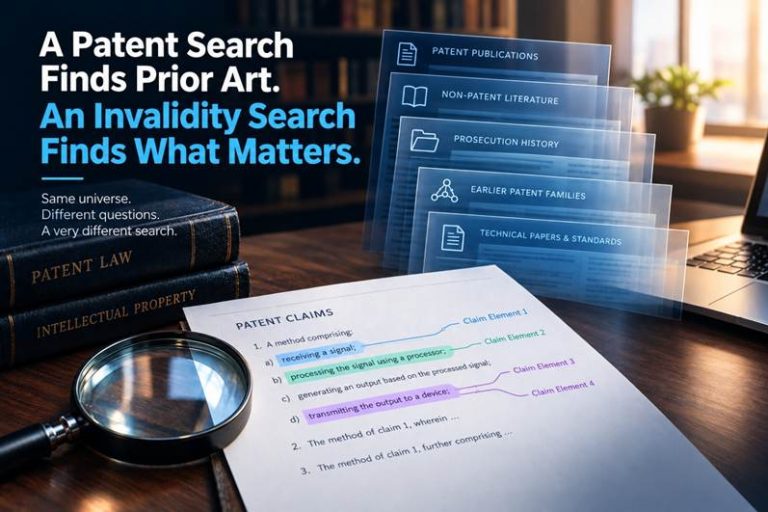
It starts with the claims — not just the technology
A conventional patent search may begin with an invention disclosure, technical concept, or description of the technology.
The researcher is trying to understand the invention and identify potentially relevant disclosures.
An invalidity search typically begins much more narrowly.
The asserted claims become the starting point.
Rather than asking simply whether a reference describes similar technology, the research needs to examine what each asserted claim actually requires.
What are the individual limitations?
Which elements are essential?
Are there particular functional, structural, or technical limitations that distinguish the claim?
And, importantly, where might those limitations have been disclosed before the relevant date?
This claim-focused approach can produce a very different search from one conducted during prosecution.
Similar technology does not necessarily mean useful prior art
One of the most common traps in prior-art research is equating technical similarity with litigation relevance.
A reference can describe technology that looks remarkably similar to the asserted patent and still have limited value if it does not disclose a critical claim limitation.
Conversely, a document that initially appears less obvious may become highly significant because it addresses a particular element of the claim that other references do not.
This is why invalidity research cannot simply be measured by the number of “relevant” documents found.
The question is not how many documents were discovered. The question is what those documents actually disclose against the claims.
The search universe can become much broader
Invalidity research can also require researchers to look beyond the sources typically associated with conventional patent searching.
Depending on the technology and the issues involved, potentially relevant evidence may exist across:
- Earlier patent publications and patent families
- Prosecution histories and cited references
- Non-patent literature
- Academic and technical publications
- Industry papers and conference materials
- Product manuals and technical documentation
- Standards and specifications
- Archived technical disclosures
- Earlier versions of websites or product information
- Related patents and applications
- References identified through litigation or prosecution history
The objective is not simply to find documents containing the right keywords.
It is to reconstruct what was known, what was disclosed, and when it was publicly available.
That temporal dimension can be critical.
A technically perfect reference published after the relevant date may tell us a great deal about the technology, but it does not necessarily serve the same purpose as an earlier disclosure.
Prosecution history can change the search
Another important distinction is the role of prosecution history.
During prosecution, claims may have been amended, narrowed, or distinguished from particular references.
Those changes can provide valuable context for subsequent research.
A reference that was considered during prosecution may not be the end of the story. It can become a starting point for identifying related publications, earlier family members, additional technical disclosures, or other references that address the same subject matter from a different angle.
For an invalidity researcher, the prosecution history can therefore provide more than background.
It can provide clues about where the boundaries of the claim were established — and where further research may be worthwhile.
One reference may not tell the whole story
Invalidity analysis also introduces another layer of complexity.
A researcher may find one reference that discloses several claim elements, while another reference addresses a different limitation.
That does not automatically mean the references establish invalidity. Legal analysis belongs with the attorneys.
But from a research perspective, identifying these individual disclosures can be extremely valuable.
It allows the litigation team to see:
Which elements are easy to find?
Which elements are difficult?
Which references address multiple limitations?
Where are the gaps?
And where might additional research produce something more significant?
This is fundamentally different from simply delivering a collection of “similar patents.”
The value is in connecting the reference to the claim
This is ultimately where the distinction between a patent search and an invalidity search becomes most apparent.
A conventional search may succeed when it identifies a highly relevant reference.
An invalidity search needs to go further.
The research needs to establish the relationship between the reference and the asserted claim.
That means examining the claim language carefully, identifying the relevant disclosure, understanding the technical context, establishing publication timing, tracing related documents where appropriate, and organizing the evidence so that attorneys can evaluate its significance.
The output therefore becomes more than a list of search results.
It becomes a body of research that can support deeper legal analysis.
Search strategy should follow the litigation question
There is no single invalidity-search methodology that works for every case.
The appropriate approach can depend on the technology, the asserted claims, the relevant dates, the prosecution history, the opposing party’s position, the available technical evidence, and the stage of the litigation.
But the underlying principle remains consistent:
Start with the litigation question, work back to the claims, and let the claims drive the research.
That is what separates an invalidity search from simply conducting a broader patent search.
At Draft n Craft, our role is to support that research process — not to make legal determinations or dictate litigation strategy.
Our researchers work across patents, prosecution histories, patent families, non-patent literature, technical publications, and related sources to help litigation teams investigate asserted claims and identify potentially meaningful prior-art evidence.
Because in patent litigation, finding a document is only the beginning.
The real question is whether the document matters to the claim.
Related Content