What is an IDS and why getting it wrong can kill your patent
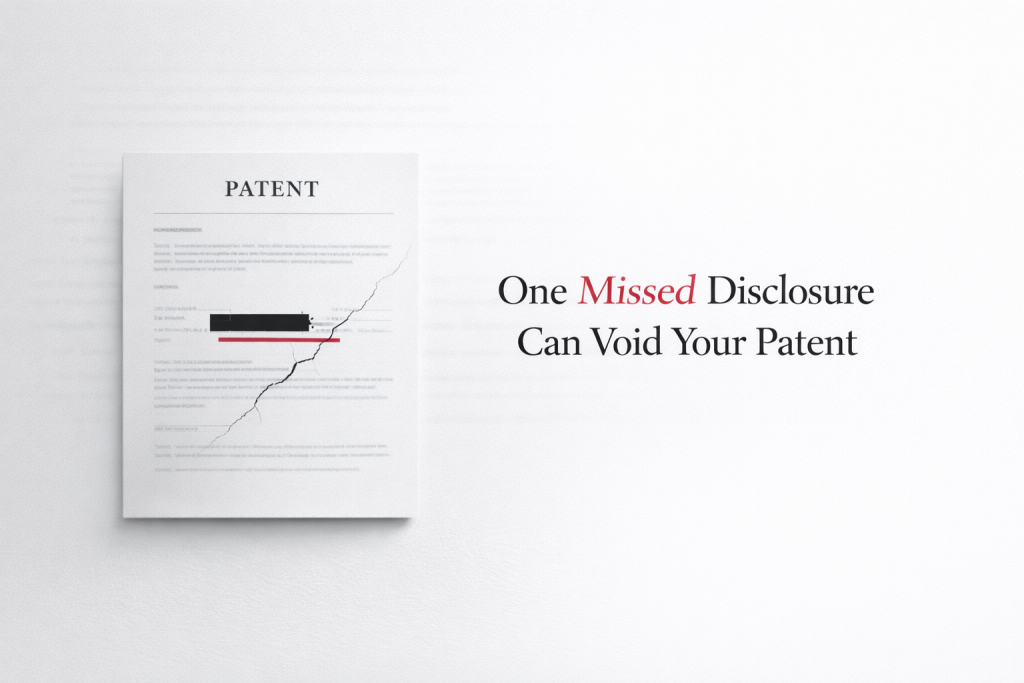
You spent years building something novel. One undisclosed reference, something you knew about and the USPTO can void everything. Here’s what every inventor and founder needs to understand about Information Disclosure Statements.
Draft n Craft IP Team · IP Docketing & Paralegal Services · 10 min read
Imagine spending 3 years and $60,000 developing a breakthrough medical device. You file your patent. It gets granted. You build a business around it. Then, four years later, a competitor challenges its validity and a court declares your patent unenforceable. Not because your invention wasn’t novel. Because you didn’t disclose a Japanese patent you knew about during prosecution.
This isn’t a hypothetical. It happens. And the document that was supposed to prevent it the Information Disclosure Statement is one of the most misunderstood obligations in all of US patent law.
So what exactly is an IDS?
An Information Disclosure Statement (IDS) is a formal document filed with the United States Patent and Trademark Office (USPTO) in which patent applicants disclose all information they know to be “material to patentability.” In plain English: you must tell the USPTO about any prior art, publications, or other references that might affect whether your invention deserves a patent.
The legal basis is 37 C.F.R. § 1.56, the USPTO’s duty of candor rule. It requires anyone involved in a patent; whether inventors, attorneys, or company members to be fully honest with the patent office. They must disclose all important information, especially anything that could affect approval.
| THE LEGAL STANDARD “Information is material to patentability when it is not cumulative to information already of record and… there is a substantial likelihood that a reasonable examiner would consider it important in deciding whether to allow the application to issue as a patent.” 37 C.F.R. § 1.56(b) |
The IDS is not a search you conduct it’s a disclosure of what you already know. If you’ve seen it, read it, or received it during prosecution, it likely belongs in your IDS.
What has to be disclosed?
The scope of disclosure is deliberately broad. Anything material to your application that you’re aware of must be disclosed. In practice, this includes:
- US patents and published applications you’re aware of that relate to your invention.
- Non-patent literature – academic papers, conference proceedings, product manuals, even websites, that describe technology relevant to your claims.
- Foreign patent applications and office actions, including examination results from the EPO, JPO, CNIPA, or any other patent authority where you’re pursuing parallel protection.
- Co-pending applications in your own portfolio that share common subject matter.
- Prior art uncovered during related litigation.
The breadth is intentional. The USPTO examiner reviewing your application can only work with what they’re given. The IDS ensures they have the full picture before granting a monopoly that will exclude others for 20 years.
“The IDS isn’t a trap, it’s a safeguard. File it honestly and completely, and it protects you. Ignore it, and it becomes the weapon someone uses to take your patent apart.”
What happens if you get it wrong?
The consequences are not theoretical. They are severe, they are permanent, and they can reach back years after your patent is granted.
| Consequence | What it means for your patent |
| Inequitable conduct | If you knowingly withheld material information with intent to deceive, a court can find inequitable conduct, rendering the entire patent unenforceable. Not just the affected claims. The whole patent. |
| Unenforceability | An unenforceable patent cannot be asserted against infringers. Your protection vanishes, even if the underlying invention was genuinely novel and non-obvious. |
| Litigation exposure | Inequitable conduct findings can expose inventors and attorneys to malpractice claims, sanctions, and reputational damage that outlast the patent itself. |
The threshold for inequitable conduct requires both materiality and intent to deceive courts don’t punish honest mistakes. But “I didn’t know I had to disclose that” is not a defence when the reference was sitting in your email inbox from a foreign patent office.
The five triggers for an IDS obligation
One of the most common mistakes is treating the IDS as a one-time filing. It isn’t. Your disclosure duty is ongoing throughout prosecution and there are five specific events that require you to file or update:
Trigger 1 – Application filing
- Any prior art you already know about must be disclosed at or shortly after filing, ideally within three months to avoid a fee.
Trigger 2 – Foreign office action received
- An EPO, JPO, or CNIPA examination result relating to the same invention must be disclosed in your US application promptly.
Trigger 3 – Newly discovered prior art
- When you become aware of new prior art, through a literature search, a competitor product launch, or third-party information – disclose it.
Trigger 4 – Continuation or RCE filing
- A fresh IDS is required, and everything that arose during the parent prosecution must be captured before proceeding.
Trigger 5 – Post-allowance, pre-issue
- If you learn of a material reference after the notice of allowance, a supplemental IDS can still be filed and must be, if the reference is truly material.
The mistake most founders make
Founders tend to think the IDS is their attorney’s problem. In one sense, yes your patent counsel drafts and files it. But the underlying duty of disclosure runs to you personally. If you read a competitor’s patent during your R&D process and never mentioned it to your attorney, that’s a gap in your IDS.
The practical fix is simple: build a habit of flagging anything patent-adjacent to your attorney competitor patents, industry publications, foreign office actions. If in doubt, disclose.
| THE THREE MOST COMMON IDS ERRORS 1. Not disclosing foreign office actions received during parallel prosecution. 2. Treating the IDS as a one-time event and missing mid-prosecution updates. 3. Failing to capture non-patent literature – academic papers, conference presentations, product specs that inventors are often more aware of than their attorneys. |
How to build an IDS process that actually works
For a single application, the IDS feels manageable. For a portfolio of 50, 100, or 300 active applications with continuation filings, PCT national phases, and parallel foreign prosecution all running simultaneously, it becomes a complex, deadline-driven operation.
An effective IDS process needs four components: a centralised intake system for references so nothing gets lost in email; a docketing infrastructure that tracks deadlines and triggers; a protocol for monitoring foreign office actions and cross-referencing them into US prosecution; and regular communication between inventors and prosecution counsel about newly discovered prior art.
For most growing companies and IP law firms, that means either a robust internal docketing team or a trusted external partner who acts as one.
How Draft n Craft helps with IDS
| 10,000+ IDS filings prepared | 50+ Years of collective IP experience | 10+ Countries served | 45+ US states served |
Our IDS services at a glance
| IDS preparation & filing Full preparation of IDS packages form PTO/SB/08, NPL formatting, citation verification filed on time, every time. Get Started Core IDS | IP docketing & paralegal Deadline tracking, prosecution monitoring, and docket management across your entire patent portfolio US, PCT, and foreign. Get Started Ongoing support |
| Foreign office action monitoring We track EPO, JPO, CNIPA and other foreign prosecution timelines and ensure material results feed back into your US IDS filings. Get Started IDS compliance | IDS compliance audits Portfolio-level review to identify gaps, missed disclosures, and corrective supplemental IDS filings before they become legal exposure. Get Started Risk mitigation |
| Continuation & RCE support Every continuation, divisional, and RCE triggers a fresh IDS obligation. We manage the carryover, update, and filing process systematically. Get Started Prosecution support | Grant & post-grant services From allowance through post-grant proceedings supplemental IDS filings, proofreading, and fee maintenance to keep your patent secure. Get Started Post-grant |
Ready to protect your patent portfolio?
Draft n Craft has prepared over 10,000+ IDS filings for law firms, in-house teams, and innovators across the US and globally. Let us handle the complexity so your patents stay protected.
Visit: draftncraft.com/intellectual-property-services
Email: info@draftncraft.com | Phone: +1-646-367-6958
Related Content