GLP-1 Receptor Agonist Litigation: MDL 3094 Developments Every Mass Tort Attorney Should Track
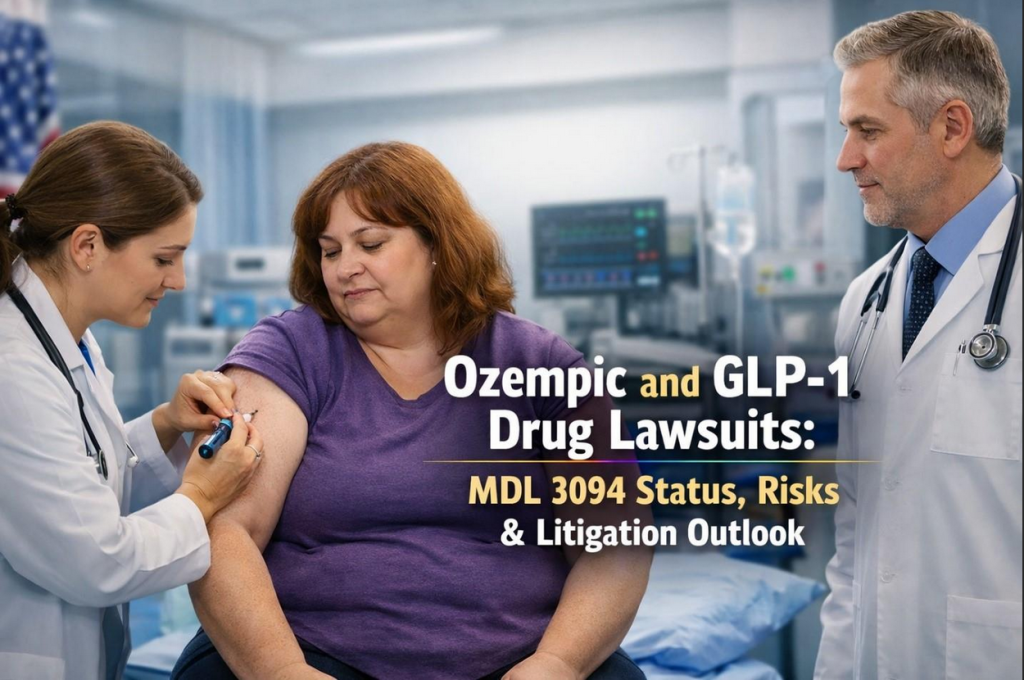
What attorneys, patients, and observers need to know in 2026
Glucagon-like peptide-1 receptor agonists (GLP-1 RAs) such as Ozempic® have transformed the treatment of type 2 diabetes, and more recently, obesity and weight management. These medications mimic the hormone GLP-1, which helps regulate blood sugar and suppress appetite, ushering in a new era of metabolic therapy.
However, alongside their clinical benefits, a rapidly expanding legal landscape has emerged, centering on product liability claims and multidistrict litigation against drugmakers over alleged serious side effects and inadequate safety warnings.

What Are GLP-1 Receptor Agonists?
GLP-1 receptor agonists are a class of injectable and oral medications that:
- Stimulate the GLP-1 receptor to increase insulin secretion and suppress glucagon.
- Slow gastric emptying (which reduces appetite and aids weight loss).
- Improve glycemic control in type 2 diabetes.
Prominent drugs in this category include Ozempic (semaglutide), Wegovy (semaglutide), Rybelsus (oral semaglutide), Mounjaro (tirzepatide) and several others. These drugs have surged in popularity, especially for weight loss, but that very popularity has brought safety concerns into sharper public view.
Clinical Updates: Evolving Medical Uses and Safety
As of January 2025, the U.S. Food and Drug Administration (FDA) approved Ozempic® with a new indication: to reduce the risk of kidney disease worsening and cardiovascular death in adults with type 2 diabetes and chronic kidney disease a major clinical milestone demonstrating broader therapeutic value beyond glycemic control.
Yet despite these benefits, some patients taking GLP-1 medications report serious gastrointestinal issues (such as gastroparesis and bowel obstruction) and, in other cases, vision injuries claims that now form the backbone of ongoing litigation.

MDL No. 3094 — In Re: GLP-1 Receptor Agonists Products Liability Litigation
Overview
In February 2024, the U.S. Judicial Panel on Multidistrict Litigation (JPML) established MDL No. 3094 “In Re: Glucagon-like Peptide-1 Receptor Agonists (GLP-1 RAs) Products Liability Litigation” in the Eastern District of Pennsylvania to centralize lawsuits alleging that manufacturers failed to warn patients and physicians about serious health risks associated with GLP-1 drugs like Ozempic, Wegovy, and Rybelsus.
This MDL brings together thousands of individual claims to streamline pretrial proceedings, avoid conflicting rulings, and establish common procedural ground.
Key Legal Developments
- Rapid Growth of Cases: As of early February 2026, the consolidated MDL had grown to 3,191 pending actions, reflecting a dramatic expansion of plaintiff participation over the last two years.
- Discovery Phase: Expert discovery where parties exchange technical, scientific, and medical evidence is scheduled to close around March 2026.
- Bellwether Trials: These initial test cases, critical for gauging broader settlement values and liability theories, are expected to begin mid-2026.
Common Allegations
Plaintiffs in MDL No. 3094 generally assert that manufacturers:
- Failed to provide adequate warnings about risks such as gastroparesis and other severe gastrointestinal reactions.
- Did not sufficiently disclose vision loss injuries, including non-arteritic anterior ischemic optic neuropathy (NAION) a distinct category now being addressed in a separate MDL (No. 3163) specifically for vision loss claims.
Separate Vision Loss MDL (No. 3163)
In late 2025, the JPML created a new MDL No. 3163 concentrating on NAION and other serious vision injuries allegedly linked to GLP-1 receptor agonists. This reflects the judiciary’s recognition that vision loss claims raise distinct factual and legal issues requiring focused coordination.
Broader Legal and Safety Landscape
The GLP-1 litigation is one of the largest pharmaceutical MDLs in recent memory rivaling classic cases in scope and complexity, with thousands of plaintiffs and multiple defendants including major drug companies.
There’s also pressure from regulators and lawmakers around compounded GLP-1 drugs, as policymakers in the U.S. call for increased FDA oversight to protect consumers from unapproved formulations marketed outside rigorous regulatory standards.
Additionally, regulators such as the European Medicines Agency (EMA) have raised broader supply and safety concerns, including drug shortages due to astronomical demand.
What Comes Next?
For Attorneys and Plaintiffs
- Bellwether trials in MDL No. 3094 could begin around mid-2026, shaping how future cases settle or proceed to verdict.
- Continued discovery and expert testimony will be central to refining liability theories and exposures.
For Patients and Clinicians
- Ongoing pharmacovigilance is critical: patients must stay informed about label changes, potential side effects, and emerging clinical evidence.
- Healthcare professionals are increasingly discussing risk profiles and long-term management strategies with patients considering GLP-1 therapy.
How Draft n Craft Supports GLP-1 MDL Law Firms
| Support Area | What We Deliver | Strategic Impact for Your Firm |
| 1. Medical Record Review & Chronology Preparation | • Comprehensive record sorting & indexing • Identification of GI complications & timeline markers • Treatment gap analysis • Causation-focused medical summaries | Clear injury timelines. Stronger causation positioning. Litigation-ready medical files. |
| 2. Demand Package & Case File Development | • Structured demand letter drafting • Settlement-ready medical summaries • Liability-aligned documentation | Faster negotiation cycles. Professionally built demand packages. Increased settlement leverage. |
| 3. Plaintiff Fact Sheet (PFS) & Discovery Support | • Organized extraction for PFS completion • Exhibit preparation • Chronological evidence building | Reduced compliance risk. Timely MDL submissions. Cleaner discovery responses. |
| 4. Mass Tort Case Management & Tracking | • Centralized tracking systems • Intake qualification review • Injury categorization • Statute of limitation monitoring | Scalable intake without chaos. Data-driven case strategy. Controlled docket growth. |
| 5. Dedicated Remote Paralegal (DRP) Model | • Trained in pharmaceutical injury workflows • MDL procedural compliance • GI & optic nerve injury terminology • Integrated with your internal systems | Operational bandwidth without overhead. Consistency across high-volume cases. Attorneys focus on strategy & bellwether prep. |
Strategic Advantage in GLP-1 Litigation
| What Winning Firms Do | How Draft n Craft Supports It |
| Maintain clean, litigation-ready files | Structured medical review & documentation systems |
| Organize evidence early | Timeline-driven summaries & record indexing |
| Track causation theory consistently | Injury mapping & documentation alignment |
| Scale intake without lowering screening standards | Intake review + categorized case tracking |
As GLP-1 MDL No. 3094 moves toward expert discovery and bellwether trials, infrastructure will determine positioning.
Draft n Craft operates as a structured backend litigation engine bringing speed, precision, and scalability to high-volume pharmaceutical dockets.