
Case Study: When Treatment Turns Into Litigation – The Suboxone Story
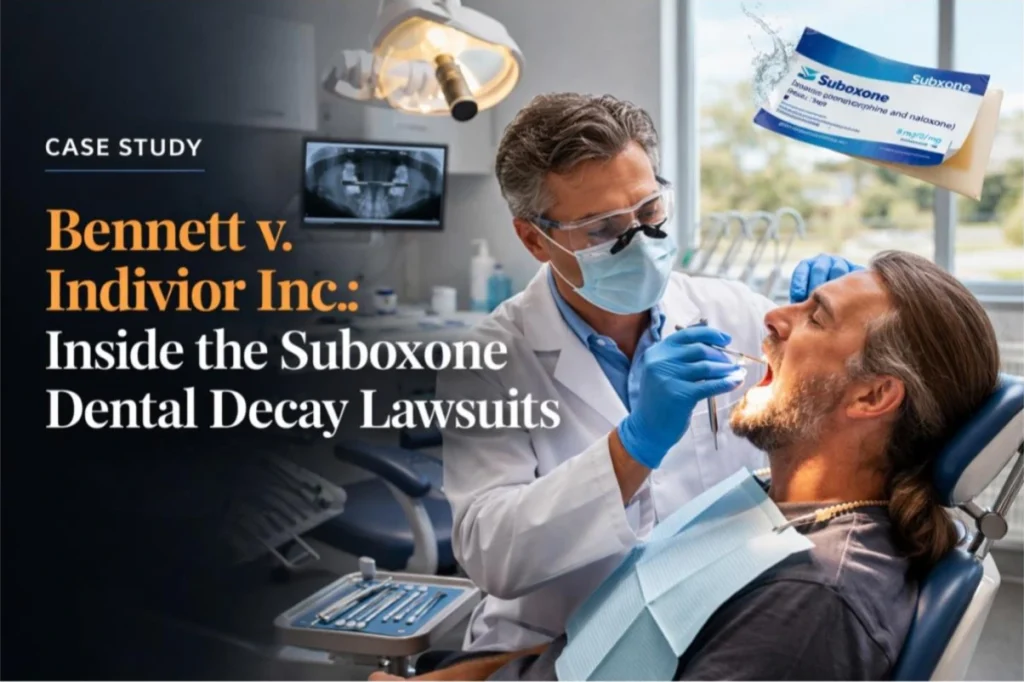
Patient Overview
Name: Ryan Bennett
Case: Bennett v. Indivior Inc., et al.
Jurisdiction: U.S. District Court, Northern District of Ohio – Suboxone (Buprenorphine/Naloxone) Film Products Liability Litigation
Judge: J. Philip Calabrese
Filing Date: November 2023
Claim: Severe dental decay, enamel erosion, and tooth loss allegedly caused by Suboxone film; failure-to-warn allegations against Indivior.
Current Status: Active in discovery as part of the nationwide Suboxone MDL.
A Recovery Journey with an Unexpected Cost
When Ryan Bennett began using Suboxone film to manage his opioid dependence, it marked a hopeful step in his recovery. The medication was meant to help him stabilize, regain control, and rebuild his life. For a time, it did.
But within a year, Ryan noticed increasing tooth pain. What started as minor sensitivity turned into serious dental problems – root canals, enamel loss, and extractions. He had no history of poor oral health, and his dentist was puzzled by the rapid deterioration.
Then, in 2022, the U.S. Food and Drug Administration (FDA) issued a safety warning linking buprenorphine medications that dissolve in the mouth – including Suboxone – to severe dental decay and tooth loss. For patients like Ryan, the warning explained what years of painful procedures could not.
The Legal Turn
Ryan filed suit against the manufacturer, Indivior, alleging that the company failed to adequately warn about the product’s dental risks. His case joined thousands of others across the country in Multidistrict Litigation No. 3092, overseen by Judge J. Philip Calabrese in the Northern District of Ohio.
As of early 2026, there are more than 1,800 active Suboxone dental injury lawsuits. The plaintiffs all tell similar stories – long-term users of the dissolvable film, now facing extensive dental damage, claiming they were never warned of the risk.
The litigation centers on key questions:
- Did Indivior know the product’s acidity could harm teeth?
- When did the company learn of these risks?
- Were warnings delayed despite available evidence?
Indivior maintains that Suboxone is safe and that it followed all FDA labeling requirements. Both sides are now in discovery – exchanging evidence, expert testimony, and years of medical data.
Inside the Case: Building Proof from Records
In complex drug-injury litigation, evidence is the spine of the story. Cases like Ryan’s depend not just on what happened but on how clearly it’s documented, connected, and presented.
This is where medical–legal support teams and paralegals become essential. They act as the bridge between raw medical data and the attorney’s litigation strategy – ensuring that every claim stands on verifiable facts.
1. Medical and Dental Record Summarization
Every treatment note, X-ray, and dental chart must be reviewed and condensed into a clear, accurate summary. Medical analysts extract critical details – onset of decay, treatment progression, and physician observations – allowing attorneys to see the case at a glance.
2. Chronology Creation
A structured medical timeline aligns Suboxone usage with emerging dental injuries. This helps identify causation patterns, revealing when the damage began relative to the medication’s start date – often a crucial element in proving liability.
3. Causation Analysis Support
Specialized reviewers analyze whether the pattern of injury matches known pharmacological effects of Suboxone’s acidic film. This medical correlation strengthens the plaintiff’s narrative before expert testimony is even introduced.
4. Expert Review Preparation
For expert witnesses – dentists, pharmacologists, toxicologists – paralegals prepare curated, indexed records with highlights, annotations, and exhibits. This structured documentation ensures that expert opinions are grounded in consistent, easily referenced evidence.
5. Plaintiff Fact Sheet (PFS) Assistance
In multidistrict litigation, plaintiffs must file detailed fact sheets summarizing their medical history and drug use. Support teams handle data extraction, cross-verification, and accuracy checks – minimizing errors that could slow or jeopardize the case.
The Role Behind the Record
While attorneys build legal arguments, paralegals and medical summarizers build the foundation those arguments stand on.
They transform thousands of fragmented medical documents into coherent, legally relevant insight – connecting science, medicine, and law in one factual line.
In a case like Suboxone, this unseen work determines how efficiently a law firm can handle hundreds of plaintiffs, how clearly experts can explain causation, and ultimately, how strong the case appears in front of a judge or jury.
In mass torts, clarity is strategy – and strategy begins with precision.\
The Broader Impact
The Suboxone litigation is more than a fight over one medication. It’s a reminder that accountability often rests on detail – in medical data, in documentation, in timing.
For every plaintiff like Ryan Bennett, there’s a team ensuring that his injury isn’t just heard but proven.
That bridge between medicine and law – built by paralegals, analysts, and medical review experts – turns evidence into advocacy and data into justice.
Explore Mass Tort Support Solutions:
Related Content