
Why Solo/Small Intellectual Property Practices Are Under Pressure in 2026
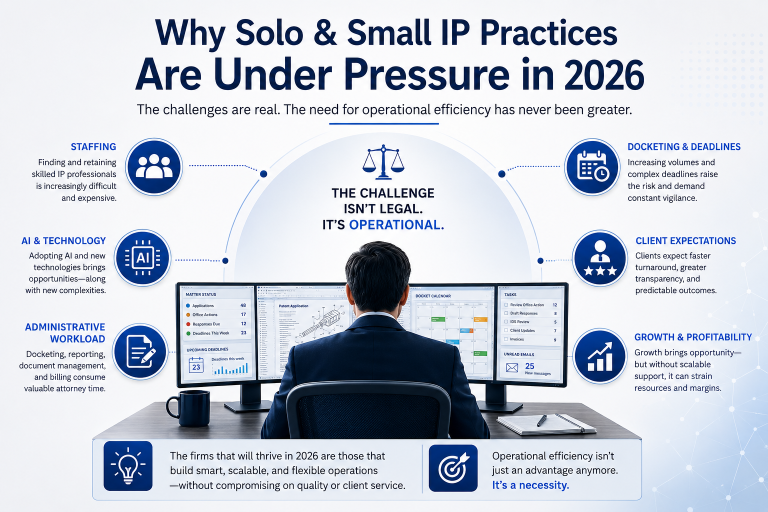
For decades, solo practitioners and small intellectual property law firms have played a vital role in helping innovators protect and commercialize their ideas. Their strengths have always been clear: specialized expertise, personalized client relationships, agility, and responsiveness.
Many clients prefer working directly with the attorney handling their matters rather than navigating layers of associates and support staff found in larger firms.
Yet as we move through 2026, many solo and small IP practices are finding themselves under increasing pressure, not because demand for intellectual property services has diminished, but because the business of practicing law has become significantly more complex.
The challenge facing many firms today is no longer purely legal.
It is operational.
The Growing Administrative Burden
Whether a firm focuses on patents, trademarks, or a combination of both, the amount of administrative work required to support client matters continues to grow.
Docket management, filing deadlines, IDS tracking, trademark maintenance, client communications, foreign associate coordination, invoicing, document management, reporting requirements, and portfolio administration all demand time and attention.
At the same time, clients expect greater transparency and more frequent updates than ever before.
What was once a straightforward status inquiry may now involve multiple communications, customized reporting, and ongoing matter tracking. These activities are important and often necessary for delivering excellent client service, but they consume valuable time that could otherwise be spent on billable legal work.
Many practitioners find themselves spending evenings and weekends handling operational responsibilities rather than focusing on strategy, prosecution, counselling, or business development.
Staffing Remains a Significant Challenge
One of the most common concerns expressed by solo and small firm attorneys today is staffing.
Finding experienced IP paralegals, docketing professionals, and administrative personnel has become increasingly difficult. Competition for qualified talent remains strong, while compensation expectations continue to rise.
Smaller firms often face challenges competing with larger organizations that can offer broader benefits, structured career paths, and larger support teams.
Even when firms successfully hire qualified personnel, turnover can create substantial disruption. Replacing institutional knowledge takes time, resources, and training.
As a result, many attorneys find themselves absorbing responsibilities that would traditionally be delegated to support staff, creating a cycle where increased workload does not necessarily translate into increased profitability.
Clients Expect More Than Ever
Today’s clients are more informed and more demanding than ever before.
Whether they are startups, universities, research institutions, or established corporations, clients increasingly expect:
- Faster turnaround times
- Greater visibility into matter status
- Consistent communication
- Predictable billing
- Efficient portfolio management
- Technology-enabled service delivery
These expectations are reasonable and reflect broader trends across professional services.
However, meeting these expectations consistently requires operational infrastructure that many smaller practices were never designed to support.
The result is a growing gap between client expectations and the resources available to deliver on those expectations.
The AI Factor
Artificial intelligence has become one of the most discussed topics within the legal profession.
For IP practitioners, AI presents both opportunities and challenges.
On one hand, AI tools have the potential to automate repetitive administrative tasks, assist with information retrieval, improve workflows, and enhance productivity.
On the other hand, clients increasingly hear claims about AI-powered legal services and may assume that legal work should now be completed faster, cheaper, or with fewer resources.
The reality is more nuanced.
While technology can improve efficiency, it does not replace legal judgment, strategic counselling, quality control, client communication, or the experience required to navigate complex intellectual property matters.
Many firms are now faced with a new challenge: determining how to leverage technology effectively while maintaining the quality and reliability that clients expect.
Growth Can Create New Problems
Growth is generally viewed as a positive development.
More clients, more filings, and larger portfolios often indicate a successful practice.
However, growth can also expose operational weaknesses.
Every new client matter brings additional deadlines, reporting obligations, communications, billing activities, and administrative requirements. Without scalable systems and support structures, growth can quickly create bottlenecks.
Many practitioners discover that attracting new business is not the hardest part of running a firm.
Managing increasing volumes of work efficiently is often the greater challenge.
The Shift Toward Flexible Support Models
One trend becoming increasingly visible across the profession is the move toward flexible operational support.
Rather than immediately adding full-time employees for every function, firms are exploring ways to access specialized expertise when needed.
Some are adopting hybrid staffing approaches that combine administrative, docketing, billing, and paralegal support into a single operational resource. Others are leveraging specialized external teams to handle critical functions without increasing permanent overhead.
The common objective is the same: creating a scalable support structure that allows attorneys to focus on client work, business development, and strategic legal guidance.
As firms continue to navigate rising costs and increasing client expectations, flexibility is becoming just as important as expertise.
Looking Ahead
The pressures facing solo and small intellectual property practices in 2026 are real, but they are not insurmountable.
The firms that will thrive over the coming years are likely to be those that view operational efficiency as a strategic advantage rather than an administrative necessity.
Technology will continue to evolve. Client expectations will continue to increase. Competition will remain intense.
Yet the core value that solo and small firms provide—specialized expertise, trusted counsel, responsiveness, and strong client relationships—remains as important as ever.
The question is no longer whether small practices can compete.
The question is how they can build the operational foundation necessary to grow sustainably while continuing to deliver the exceptional service their clients expect.
As the profession continues to evolve, firms that successfully balance legal excellence with operational efficiency will be best positioned for long-term success.
About the Author
Arvinder Singh is Senior Vice President at Draft n Craft IP Services and works closely with patent and trademark professionals across North America and Europe. Through conversations with solo practitioners, boutique IP firms, and corporate IP teams, he regularly explores the operational challenges shaping the future of intellectual property practice.
If you would like to discuss how firms are addressing staffing, workflow management, docketing, paralegal support, and operational scalability, feel free to connect with him on LinkedIn.