
The Hidden Cost of a Missed IP Deadline
No IP professional wakes up in the morning planning to miss a deadline.
Yet every year, patent applications become abandoned, trademark filings lapse, maintenance fees are overlooked, and renewal deadlines slip through the cracks. Not because people don’t care, but because intellectual property has become increasingly complex to manage.
A growing portfolio. More jurisdictions. More correspondence. More deadlines. More pressure.
And all it takes is one date being missed.
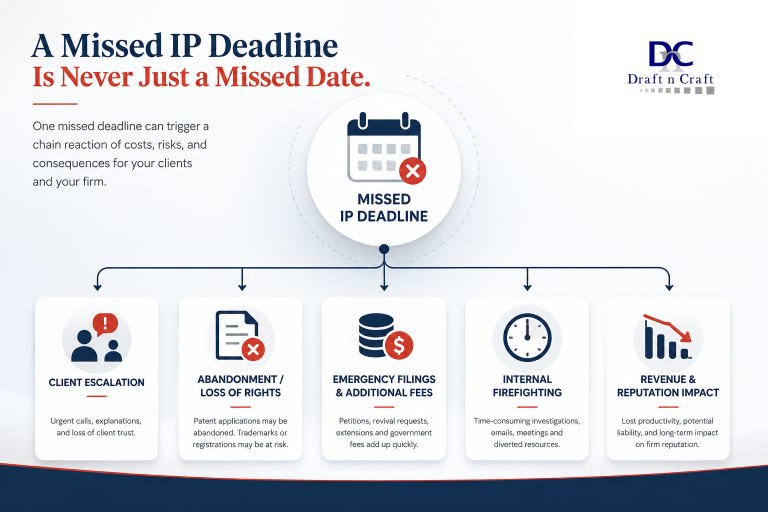
When most people think about a missed patent or trademark deadline, they think about government fees. A petition fee. An extension fee. Perhaps the cost of reinstating an application or reviving a patent.
But after spending years working with IP professionals, I’ve come to believe that those costs are often the least significant part of the problem.
The real cost usually shows up somewhere else.
It Starts with One Uncomfortable Conversation
Imagine having to call a client and explain that a patent application has gone abandoned because a response deadline was missed.
Or informing a trademark owner that a registration they spent years building their brand around is now at risk because a renewal filing was overlooked.
In many cases, the issue can be corrected. Petitions can be filed. Rights can sometimes be restored.
But the client rarely remembers the petition fee.
They remember the phone call.
They remember the uncertainty.
And they remember wondering whether their intellectual property was being managed as carefully as they expected.
Trust takes years to build and only moments to damage.
The Cost That Never Appears on an Invoice
What happens after a missed deadline is rarely visible to the client.
Attorneys start reviewing correspondence.
Paralegals search records and timelines.
Docketing professionals investigate what happened.
Managers become involved.
Emails multiply.
Meetings get scheduled.
People stop working on planned activities and start managing a crisis.
A single missed deadline can consume dozens of hours across multiple team members.
The official fee may be a few hundred dollars.
The operational cost is often much higher.
Patent and Trademark Deadlines Are Different—But the Risk Is the Same
In patent prosecution, a missed Office Action deadline can result in abandonment. A missed maintenance fee can jeopardize valuable patent rights. International filing deadlines can sometimes close doors permanently.
In trademark practice, missing an Office Action response or renewal deadline can put important brand assets at risk. For a client actively building market recognition, even a temporary loss of rights can create significant business challenges.
The details differ.
The consequences don’t.
Both ultimately come down to protecting something valuable for the client.
Most Deadline Failures Are Process Failures
When firms investigate missed deadlines, they rarely discover a single catastrophic mistake.
More often, they uncover a series of small breakdowns.
An email wasn’t reviewed.
A deadline was entered incorrectly.
A reminder was overlooked.
A backup resource wasn’t available.
An assumption was made that someone else was handling it.
None of these issues seem significant on their own.
Together, they can become a serious problem.
That’s why successful IP practices don’t rely on individual heroics. They rely on systems, processes, and multiple layers of review.
Why Docketing Matters More Than Ever
For many years, docketing was viewed as an administrative function.
Today, I would argue it is one of the most important risk-management functions within an IP practice.
The best docketing teams do far more than track dates.
They create visibility.
They provide accountability.
They identify potential issues before they become client problems.
Most importantly, they help ensure that critical deadlines do not depend on a single person, inbox, or software system.
The Best Protection Is Redundancy
One lesson I’ve learned from working with IP professionals is that the strongest practices build redundancy into everything.
They have trained people.
Documented processes.
Quality checks.
Backup coverage.
Escalation procedures.
Technology plays an important role, but technology alone is rarely enough.
When valuable patent and trademark rights are involved, firms need both systems and experienced people working together.
Final Thoughts
A missed IP deadline is rarely about a date on a calendar.
It’s about client confidence.
It’s about professional responsibility.
It’s about protecting innovations, brands, and business assets that may have taken years to build.
Most importantly, it’s a reminder that effective IP management isn’t simply about tracking deadlines—it’s about creating processes that ensure those deadlines never become a client’s problem.
Because in intellectual property practice, the most expensive deadline is often the one that everyone thought someone else was watching.
This piece reflects my experience working with IP law firms across patent and trademark prosecution. The insights shared are based on real-world operational challenges observed in managing IP deadlines and workflows.
Arvinder Singh
Sr. Vice PresidentDraft n Craft